Buying a Wig for the First Time? Avoid These 15 Mistakes
May 14, 2026 · Marcus Vore
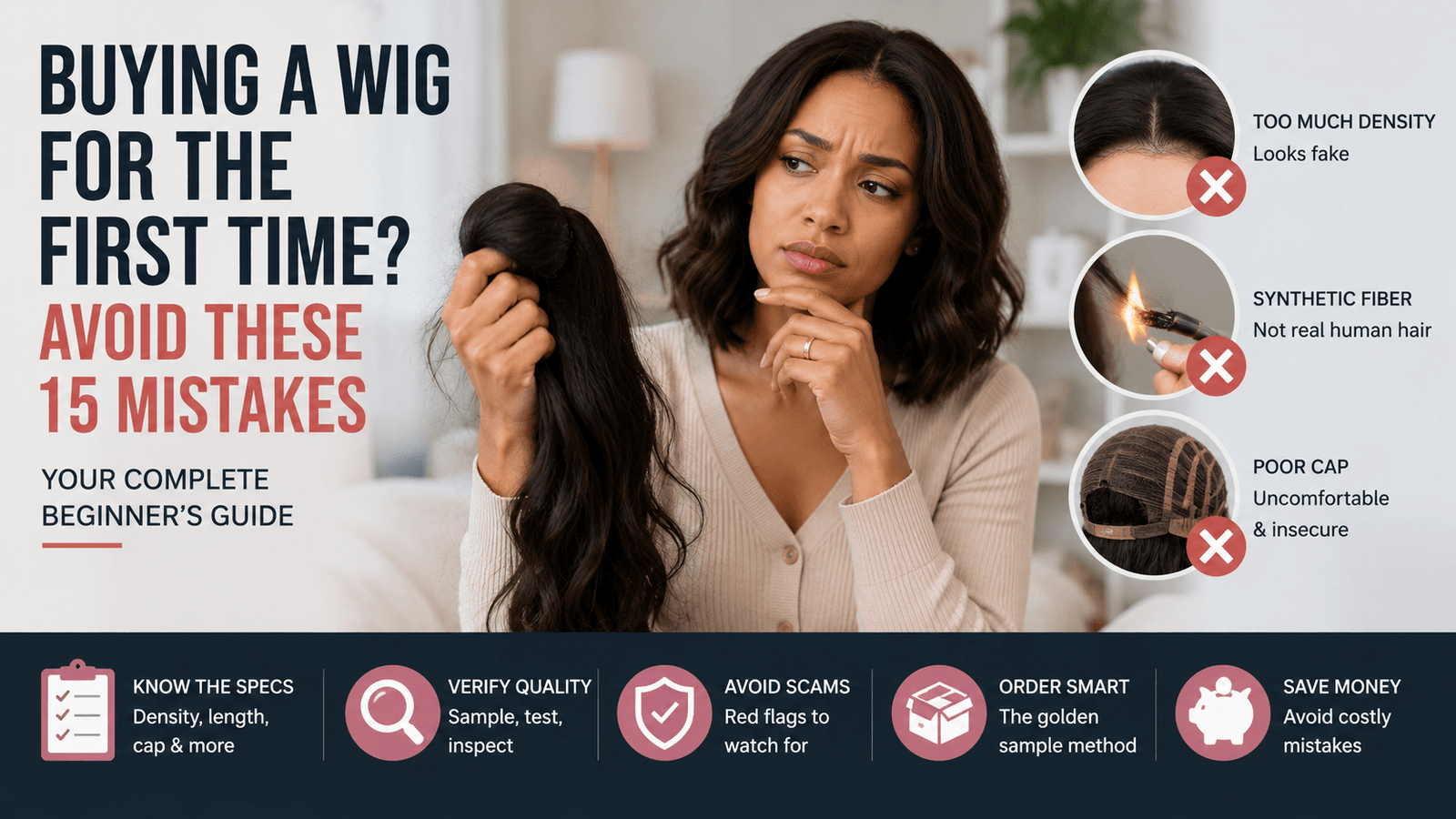
Buying a wig for the first time? The most expensive mistake you can make isn't choosing the wrong color or style — it's ordering without understanding the specs that determine quality, and paying before you verify what you're actually getting. This guide walks through the 15 most common wig buying mistakes, from density traps and cap construction confusion to the supplier scams that catch even experienced buyers off guard.
Last year, a buyer we'll call Lisa placed her first wholesale wig order: 50 units of "180% density virgin human hair" at $38 per piece from a supplier she found online. The sample photos looked flawless. The price was $12 below every other quote she'd received. The supplier was responsive, friendly, and sent her a WhatsApp voice note promising "premium quality, guaranteed."
Six weeks later, Lisa's inventory arrived. The wigs looked fine in the box, so she listed them on her Shopify store at $129 retail.
Within 10 days, the returns started. Shedding. Tangling after the first wash. Lace that ripped during normal application.
She tested a strand with a lighter: half the hair melted. Synthetic blend, not virgin human hair.
Lisa lost $1,900 on the order, $600 on return shipping, and 14 negative reviews that took eight months to bury. What she needed was a sourcing partner with a documented quality verification process — factory audit, sample approval, production QC, and pre-shipment inspection — instead of blind trust in a stranger's WhatsApp message.
Key Takeaways - Start with 150% density, lace front, glueless cap, shoulder-length, the safest combination for first-time buyers that looks natural and is manageable - Never place a bulk order without first testing physical samples: a burn test catches synthetic blends, a shed test reveals construction quality, and a wet test exposes silicone-coated hair - The biggest tell that a wig will look fake is density over 180%, more hair doesn't mean better, it means heavier, hotter, and harder to style - If buying wholesale for resale, always use the golden sample method: approve one physical unit, document every spec, and reject bulk orders that don't match - Quality verification isn't distrust, it's the difference between a profitable business and an expensive lesson
The Density Trap: Why "More Hair" Creates the #1 Beginner Mistake
Density is the most misunderstood spec in wig buying — and the one that causes the most regret. Among all first time wig buyer mistakes, choosing density that's too high tops the list because it's expensive and impossible to fix after purchase.
Wig density refers to the number of hair strands per square inch on the cap, expressed as a percentage of an average natural head of hair. 100% represents a full head of natural hair. Every percentage above that adds proportionally more hair to the cap. According to Grand View Research, wigs account for nearly 75% of the $15.2 billion global hair wigs and extensions market — which means density is a spec that affects a massive number of buyers every year.
The mistake most beginners make: assuming higher density equals higher quality, so they order 200% or 250%. What arrives is a wig that looks obviously fake, bulky, helmet-like, too heavy for comfortable daily wear, and prone to tangling because the sheer volume of hair creates friction at the nape.
Here's what each density tier actually looks like in real life:
| Density | Visual Result | Best For | Wholesale Cost Impact |
|---|---|---|---|
| 130% | Light, airy, most natural-looking | Daily wear, older customers, hot climates | Base price |
| 150% | Medium fullness, natural movement | The most popular choice across all markets | +$2-3 per unit |
| 180% | Full, glamorous, noticeable volume | Younger customers, social media, special events | +$5-7 per unit |
| 200% | Very full, dramatic | Caribbean and African markets, performance | +$7-10 per unit |
| 250% | Maximum volume | Drag, stage, specific cultural preferences | +$10-15 per unit |
The price differences come from raw material cost: a 200% density wig uses roughly 50% more hair than a 130% density wig. That's real manufacturing cost, not arbitrary markup.
For your first wig, stick with 150%. It satisfies the widest range of preferences, looks most natural, and has the lowest return rate. If you're buying for resale and can stock two densities, add 180% as your second option.
How Density Interacts With Length and Texture
Density doesn't exist in isolation. A 200% density 28-inch wig is uncomfortably heavy, roughly 280-320 grams of hair pulling on your scalp all day. A 150% density 14-inch bob weighs about 130-150 grams and feels nearly weightless.
Texture also changes the equation. Curly and wavy textures appear much fuller than straight hair at the same density. A 150% density deep wave wig looks as full as a 180% straight wig. Factor this in when comparing products: if you want the fullness of 180% but prefer lower maintenance, choose 150% in a body wave texture instead.
Human Hair vs. Synthetic: The Decision Most Beginners Get Wrong
When David started his e-commerce wig business, he assumed "human hair = premium, synthetic = cheap" and stocked only human hair units. Six months in, his return rate was 22%. His customers, mostly first-time wig wearers, were overwhelmed by the maintenance: daily styling, heat protection, special washing products.
David's mistake wasn't choosing human hair. It was choosing it for the wrong customers.
When Human Hair Is Worth It
Human hair wigs last 1-4 years with proper care, can be heat-styled and colored, and look the most natural in person. They're the right choice when your customer values styling flexibility and longevity over convenience.
Wholesale reality: Genuine virgin human hair wigs start at roughly $45-60 per unit at wholesale for basic constructions. Anything significantly below that price point is almost certainly not 100% virgin human hair — it's blended, processed, or mislabeled. The human hair wig segment alone was valued at $1.81 billion in 2025 (Fortune Business Insights), driven by buyers who prioritize natural appearance and styling flexibility over upfront cost.
When Synthetic Is the Better Business Decision
Modern premium synthetic fibers have improved dramatically. Heat-friendly synthetic wigs can be styled up to roughly 160°C (320°F), hold their shape after washing, and cost a fraction of human hair at wholesale. For customers who want a "put it on and go" experience, synthetic often produces higher satisfaction and fewer returns.
The synthetic spectrum matters: a $35 heat-friendly synthetic wig from a quality factory is a completely different product from a $5 basic synthetic wig. The difference is in the fiber grade, cap construction, and knotting quality, not just the label "synthetic."
How to Verify Hair Type Before You Pay
If you're buying human hair — especially wholesale — knowing how to verify wig quality before money changes hands is the single most important skill in this guide. Here are the three tests that catch what photos hide:
The burn test: Cut a small strand (5-10 hairs), hold with tweezers, and light with a match. Human hair burns slowly with white smoke, smells like burning protein, and turns to fine ash that crumbles when touched. Synthetic hair melts into a hard black bead and smells like burning plastic. Blends show both behaviors, some strands ash, some melt.
The bleach test: Bleach a test strand to #613 blonde. If the hair lifts evenly and retains its texture, it's healthy virgin hair. If it turns patchy, frizzy, or breaks, it's been chemically processed and coated to hide damage. This test reveals what suppliers don't want you to see, because once silicone coating washes off after a few customer washes, the real (damaged) hair underneath is what your customers will experience.
The wet test: Wet a section of hair completely, feel the texture, and let it air dry. Good quality hair feels smooth when wet and returns to its original texture when dry. Silicone-coated hair feels unnaturally slippery when wet, the coating won't rinse out, and after 3-5 washes, the coating strips away and the hair underneath is rough, tangled, and unmanageable.
Pro Tip: Ask your supplier to do the burn test on video before you order samples. A confident supplier will do this without hesitation. A supplier who makes excuses, "we can't damage the product," "our quality is guaranteed", is telling you something about what they're selling.
Cap Construction: The Comfort Factor Nobody Explains
Cap construction determines how a wig feels on your head, how natural the hairline looks, and how versatile the styling options are. Here's what each type actually means for the wearer:
Lace front wigs have a sheer lace panel at the front hairline, creating the illusion that hair grows directly from the scalp. This is the minimum you want for a natural look: no hard line across the forehead, no obvious "wig line." Most beginners should start here.
Full lace wigs have lace across the entire cap, allowing you to part the hair anywhere and style it in any direction. The trade-off: they're more expensive, more delicate, and harder to put on. Not recommended for first-time buyers.
360 lace wigs have lace around the entire perimeter, enabling high ponytails and updos. Good for versatility, but more maintenance than a standard lace front.
Glueless wigs eliminate the need for adhesive, they stay on with adjustable straps, combs, and an elastic band. For first-time buyers, glueless is the safest choice. No glue means no allergic reactions, no damage to your natural hairline, and the ability to take the wig off at night. If you're buying your first wig, look for "glueless lace front" in the product description.
Basic wefted caps are the most affordable construction, hair is sewn onto rows (wefts) attached to a closed cap. They work fine for wigs with bangs that cover the hairline, but on a style pulled back from the face, the hairline looks obviously artificial. Budget-friendly, but limited.
How to Measure Your Head for the Right Cap Size
This takes 60 seconds and prevents the #1 comfort complaint: buying the wrong size. Most wigs come in Small (21-21.5 inches), Average (22-22.5 inches), and Large (23-23.5 inches). About 90% of adults fit average, but measure anyway, a too-tight wig causes headaches, and a too-loose wig slides and looks unnatural.
Measure three points with a soft tape measure: circumference (around your hairline from forehead to nape and back), front-to-nape (from the middle of your front hairline straight down to the nape of your neck), and ear-to-ear (across the top of your head from temple to temple). Most wig size charts use circumference as the primary measurement, but all three matter for a good fit.
Buying a Wig for the First Time Online? 5 Ways You Can Get Scammed
Most guides on how to buy a wig for beginners tell you what to purchase. They skip the most important part: how to protect yourself during the transaction. Here's what those guides leave out.
1. The "Sample Was Perfect, Bulk Was Garbage" Problem
A supplier sends you a flawless sample. You approve it, pay for 100 units, and what arrives barely resembles what you approved. This is called bait-and-switch, and it's the most common scam in the wig trade.
How to protect yourself: Use the golden sample method. When you receive and approve a sample, document everything: weight in grams, density appearance in photos, lace color, curl pattern, construction details.
Send these documented specs back to the supplier in writing: "This sample (attached photos and measurements) is our approved quality standard. The bulk order must match these specifications."
When your bulk order arrives, compare against the golden sample before accepting it into inventory. A reputable supplier welcomes this process. A bad one will push back.
2. Stock Photos vs. Reality
Studio photos with professional lighting, filters, and editing can make a $15 synthetic wig look like a $150 human hair unit. The color, shine, and volume you see on screen may bear little resemblance to what arrives in the box.
How to protect yourself: Demand unedited photos and videos in natural light. Request a video where the supplier runs their fingers through the hair root-to-tip and tip-to-root, this reveals tangling and shedding that photos hide. Ask for photos of the wig both dry and wet. If a supplier won't provide these, they're hiding something.
3. Prices That Are Too Good to Be True
Here's what a wig actually costs to manufacture, roughly:
| Quality Tier | Wholesale Price Range | What It Means |
|---|---|---|
| Basic synthetic | $2-10 per unit | Basic fiber, machine-made cap, limited lifespan |
| Mid-range synthetic / heat-friendly | $10-25 per unit | Better fiber, improved cap, holds style |
| Basic human hair (processed, non-Remy) | $25-45 per unit | Real hair but chemically processed, shorter lifespan |
| Quality human hair (Remy) | $45-80 per unit | Aligned cuticles, less tangling, better durability |
| Premium virgin human hair | $80-280+ per unit | Single-donor, unprocessed, longest lifespan |
If someone offers you "virgin human hair" at $30 per unit, the math doesn't work. Raw hair material alone costs more than that before manufacturing, cap construction, and shipping. What you're actually getting at that price is processed hair, a synthetic blend, or hair that's been acid-washed to strip cuticles and then silicone-coated to look healthy, until the first wash.
4. No Live Video Verification
In 2026, every legitimate factory has smartphones with video capability. If a supplier can't do a real-time video walkthrough of their production floor within 24 hours of your request, that's a red flag. Industry events like the annual China Hair Expo in Guangzhou (August 1-3, 2026) also provide opportunities to meet manufacturers in person and inspect products hands-on before committing to orders. Some "suppliers" are trading companies that have never set foot in the factory producing your order.
What to ask for on video: Running production line (not just a showroom or office), workers actively constructing wigs, close-up of cap construction and knot work, and the supplier handling the actual hair you'll receive.
5. Payment Terms That Put You at Risk
Never pay 100% upfront to a supplier you haven't worked with before. Standard trade terms are 30% deposit to start production, 70% balance after you approve pre-shipment inspection photos and videos. If a supplier demands full payment upfront, especially via wire transfer, walk away.
For first-time orders with a new supplier, use a platform with payment protection like Trade Assurance. It's not perfect, but it gives you a dispute process. Direct wire transfers to unknown suppliers offer zero recourse if something goes wrong.
If You're Buying to Resell: Wholesale-Specific Pitfalls
If your first wig purchase is a wholesale order for your business, salon, e-commerce store, boutique, there are additional mistakes that consumer guides never cover.
How Many Units Should a First Order Be?
Any wholesale wig buying guide worth reading will tell you the same thing: start small. Order 10-20 pieces split across 2-3 styles, not 100 units of a single SKU. A small first order lets you test customer response, verify quality consistency across the batch, and refine your specs before committing significant working capital.
The suppliers who pressure you into a large first order, "minimum 100 pieces for this price", are prioritizing their cash flow over your business. Good suppliers will accommodate reasonable test orders, even if the per-unit price is slightly higher. The higher sample cost is insurance against a much larger loss.
Understanding Your Real Cost Per Unit
The sticker price on a wig is only part of the cost. Your actual landed cost per unit includes:
- Unit price (the quote from your supplier)
- Sample costs (typically $10-50 per sample, often credited against future orders)
- Shipping (sea freight vs. air freight vs. express: costs and timelines vary significantly by method)
- Customs duties and broker fees (varies by country and product classification)
- Quality inspection costs (either your time or a third-party service)
- Return and defect reserve (budget 3-8% of order value)
A wig quoted at $40 per unit can land at $52-58 after everything. Calculate this before you commit to an order, it determines whether your retail pricing actually works. For a deeper breakdown, see our guide to import duties and taxes.
Wig Care Mistakes That Cut Lifespan in Half
Even the best wig won't last if it's not maintained properly. These are the care mistakes that destroy wigs fastest:
Using regular hair products on wigs: Standard shampoos contain sulfates that strip wig fibers. Heavy conditioners and oils coat synthetic strands and attract dust. Use products specifically formulated for wigs, they're designed for the fiber type and won't cause buildup or degradation.
Over-brushing: This is especially damaging to synthetic wigs, which lack the natural elasticity of human hair. Every brush stroke creates micro-friction on the fibers. Brush only when needed, to detangle after wearing or before washing, and always use a wide-tooth comb starting from the ends, working upward.
Improper storage: Leaving a wig loose in a bag or drawer causes tangling, matting, and cap deformation. Store on a wig stand or mannequin head to maintain shape. Keep away from direct sunlight (UV damages both human and synthetic fibers) and dust.
Washing too often or not enough: Human hair wigs need washing every 7-10 wears. Synthetic wigs need washing every 10-15 wears. Washing too frequently strips fibers; washing too infrequently leads to product buildup, odor, and tangling.
Heat damage on synthetics: "Heat-friendly" doesn't mean heat-proof. Most heat-friendly synthetic fibers tolerate up to 160°C (320°F), well below the 180-230°C used for human hair. Exceed this and fibers melt, warp, or frizz irreversibly.
7 Reasons Your Wig Looks Fake (And How to Fix Each One)
Sometimes the problem isn't the wig, it's how it's worn. Here are the most common reasons a wig reads as "wiggy" and what to do about each:
-
The hairline looks too perfect: Real hairlines aren't ruler-straight with perfect density. Pluck a few hairs along the front hairline to create slight irregularity. Use a zig-zag cut when trimming lace (never cut straight across, it creates a hard line). Blend the lace with foundation or concealer that matches your scalp, not your face.
-
Synthetic shine: Synthetic wigs often have an unnatural gloss that screams "fake." A light dusting of dry shampoo or translucent powder dulls the shine to a natural matte finish. This one 30-second fix transforms how a synthetic wig photographs.
-
The density is overwhelming: 200%+ density looks dramatic on camera but unrealistic in person. The hair sits too high off the head, doesn't move naturally, and creates a bulky silhouette. If your wig looks like a helmet, the density is too high, and no amount of styling can fix that. Choose 130-150% for daily wear.
-
Wrong placement: Wearing a wig too far forward is the most common positioning error. Place the wig about four finger-widths above your eyebrows. If the hairline sits lower than that, the proportions look off and the lace becomes more visible.
-
Visible lace that doesn't match: Lace should blend with your scalp, not sit on top of it looking like a different color. Tint the lace with fabric dye or foundation to match your skin tone. For HD lace, this is less critical, the material is nearly invisible, but for Swiss lace and standard lace, color matching makes the difference between detectable and undetectable.
-
Bulky natural hair underneath: If your own hair isn't flattened properly under the wig, it creates lumps and bumps at the crown and sides. Braid hair flat against the scalp in cornrows or flat twists. Use a wig cap to smooth everything down. The flatter your base, the more natural the wig sits.
-
Not customizing the part: A factory-made part line looks like a straight line of knots with no scalp visible. Pluck a few hairs along the part to widen it slightly and create the look of natural scalp peeking through. A pre-plucked wig saves this step, but most wigs benefit from additional customization.
Frequently Asked Questions
What is the single biggest mistake first-time wig buyers make?
Choosing the wrong density. Beginners consistently order wigs that are too thick (200%+), which look unnatural, feel heavy, tangle faster, and cost more. 150% density is the safest starting point for a natural look.
How do I know if a wig is good quality before buying?
Request a physical sample and test it: burn a few strands (human hair turns to ash, synthetic melts), brush 10 times and count shed hairs (0-8 is acceptable, 15+ is reject), wet a section and let it air dry (rough texture after drying = processed/damaged hair). Photos alone can't tell you what these tests will reveal.
Should a beginner buy human hair or synthetic?
It depends on your priorities. Choose synthetic if you want low maintenance and a lower upfront cost, modern heat-friendly synthetics look surprisingly natural. Choose human hair if you want maximum styling flexibility, the most natural movement, and are willing to invest the time in maintenance. For wholesale buyers, stock both and let customer demand guide your ratio.
What wig density looks most natural?
130-150% density looks most natural for everyday wear. 180% reads as "full", fine for events and social media, but noticeably thick in person. 200% and above looks dramatic and rarely passes as natural hair, especially in daylight.
How can I avoid getting scammed buying wigs online?
Five non-negotiables: (1) never pay 100% upfront to a new supplier, (2) always test physical samples before bulk ordering, (3) demand a live video call showing the production floor, not a showroom, (4) verify hair type with a burn test, and (5) use the golden sample method, document your approved sample's specs and reject bulk orders that don't match. For more on finding trustworthy suppliers, read our guide on how to find reliable suppliers in China.
How long should a good wig last?
Quality human hair wigs last 1-4 years with proper care. Heat-friendly synthetic wigs last 6-12 months of regular wear. Basic synthetic wigs last 3-6 months. The lifespan difference is primarily about fiber quality and maintenance, not luck.
What's the difference between Remy and virgin hair?
Virgin hair is collected from a single donor, never chemically processed (no dye, no perm, no bleach), and has cuticles intact and aligned. It's the highest grade of human hair. Remy hair has aligned cuticles (reduces tangling) but may have been lightly processed, colored, permed, or steamed. Both are real human hair, but virgin commands a higher price and lasts longer because it hasn't been chemically stressed.
Buying a Wig for the First Time Shouldn't Be a Gamble
The difference between a wig purchase you regret and one that builds your confidence — or your business — comes down to what you check before you pay. Not the photos. Not the sales pitch. The actual specs, verified with actual tests.
Start with the right combination for a beginner: 150% density, lace front, glueless cap, in a shoulder-length natural texture. Test before you invest. And if you're buying wholesale, never skip the golden sample stage, it's your physical insurance policy against every bait-and-switch horror story you've read.
Want help sourcing wigs with verified quality specs? We send pre-shipment inspection photos and videos on every order so you know exactly what's arriving before you pay the balance. No surprises, no excuses.
- WhatsApp: +86 17347350405 (fastest response)
- Email: hello@voretrade.com
Whether you buy from us or someone else, the verification steps in this guide will protect your investment. Have questions about your specific sourcing needs? Get in touch — we respond within 24 hours. A confident buyer is a better buyer, and that's good for the entire industry.