How to Build a Wig Product Line for a Small Beauty Store: The Complete Curation Guide
June 7, 2026 · Marcus Vore
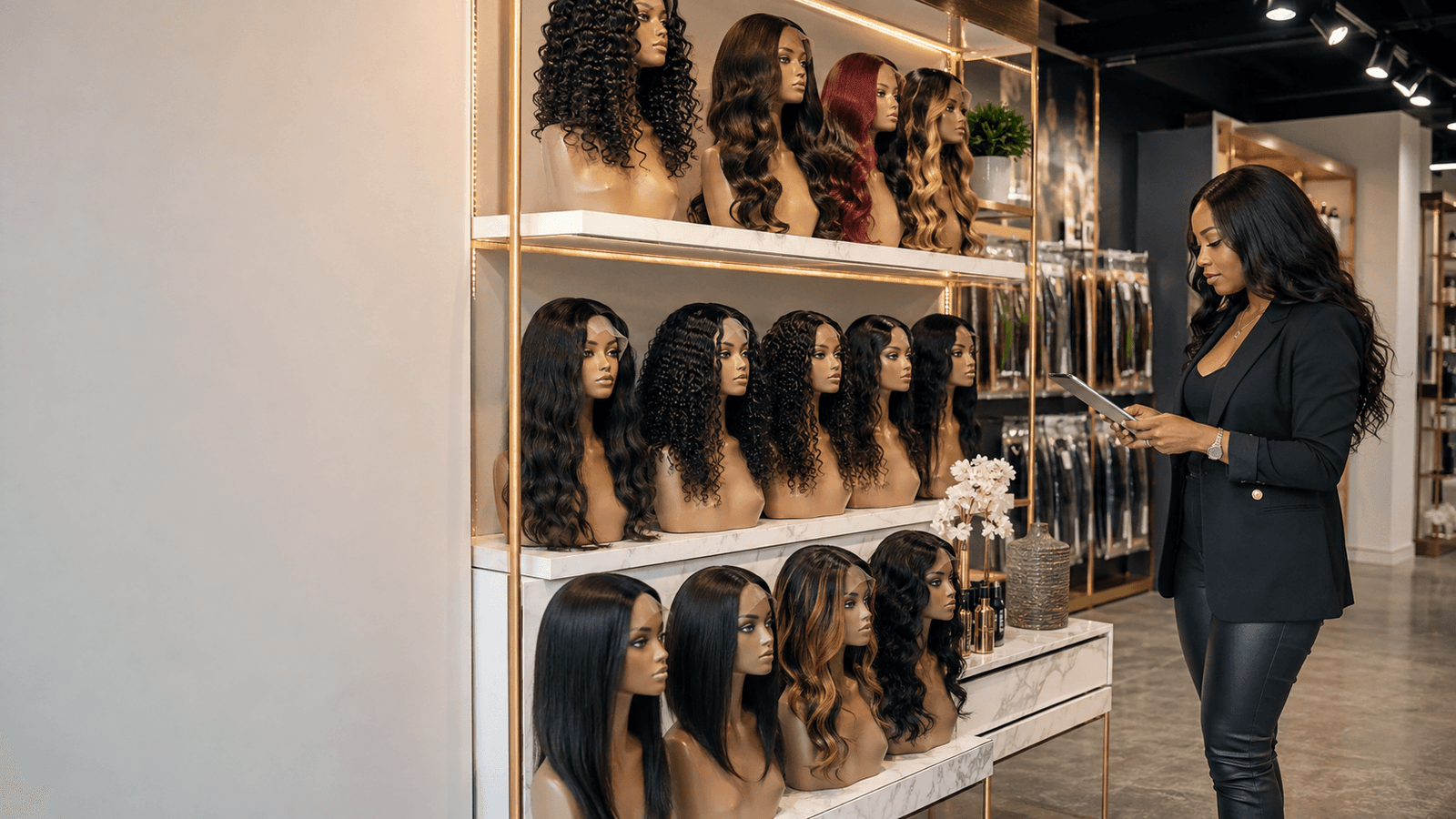
Build your wig product line around a 3-tier structure: Entry (40% of SKUs, $25-$80 retail) for customer acquisition, Core (40%, $100-$300) as your profit engine, and Premium (20%, $300-$800+) for authority. Start with 12-20 styles across those tiers, matched to your specific customer segments -- not random trending styles you saw on Instagram.
When Lisa opened her beauty supply store in Atlanta last year, she did what most first-time owners do: she stocked wigs based on what looked good on the supplier's website. Twenty-five styles across every texture and color she could find. Six months later, seven styles had never sold a single unit. Another eight had sold once. She had $4,200 tied up in dead inventory -- and the styles that did sell were already out of stock because she'd only ordered one of each.
Lisa's problem wasn't her market. It was her product line architecture. She had a catalog, not a collection. And in a small beauty store where shelf space and cash are limited, those are very different things.
Key Takeaways - Structure your product line in 3 tiers: Entry (40% of SKUs), Core (40%), Premium (20%) -- each with a different job in your business. - Lace front wigs in body wave and straight textures, 16-22 inches, natural black (#1B) should be the spine of your line. - Start with 12-20 wig styles total; add 2-3 new styles per quarter based on sales data, not instinct. - Source direct from Xuchang, China to cut unit costs 30-50% vs. US distributors, but verify with samples before bulk. - Every wig sale should trigger a $15-$40 accessories add-on -- caps, glue, edge control, care products at 60-80% margins.
Why Your Product Line Is Your Business Strategy
A catalog is everything you can get. A collection is an intentional selection that tells your customers who you are and who you serve.
In a physical beauty store, customers browse differently than they do online. They touch the lace. They hold the wig up to their face in the mirror. They ask to see the hairline under the store lighting. Your product line needs to work for both the browser who walks in curious and the repeat customer who knows exactly what density and texture she wants.
The store that stocks 50 styles with one unit each looks full -- until a customer asks for a second unit in her size and there isn't one. The store that stocks 15 styles with 2-3 units each can say yes. Depth builds repeat customers. Breadth without depth burns them.
A focused product line also builds your store's reputation. When customers learn that everything on your shelves is quality you've vetted, they stop inspecting and start trusting. That's the same principle behind our 4-step verification process — trust built on documented quality checks, not promises.
Define Your Customer Before You Choose Your Products
Your product line should be a mirror of your customer base. Not the customer base you wish you had -- the one that actually walks through your door.
The Five Customer Segments in Wig Retail
| Customer Segment | What They Need | Best Wig Types | Density | Price Range |
|---|---|---|---|---|
| Beginners | Easy to wear, forgiving, affordable | Glueless, T-part, headband wigs | 130-150% | $25-$80 retail |
| Experienced wearers | Premium hairline, custom density, styling flexibility | 13x6 HD lace, full lace | 150-180% | $150-$350+ retail |
| Medical hair loss | Comfort, natural scalp look, security, discretion | Monofilament, silk top, glueless | 100-130% | $80-$200 retail |
| Fashion/trend buyers | Bold colors, trendy cuts, frequent rotation | Colored synthetic, bob cuts, ombre styles | Varies | $30-$80 retail |
| B2B salon/stylist | Consistent specs, reorder reliability, professional finish | 13x4 lace front, body wave, straight | 150% | $80-$180 wholesale |
Before you order a single wig, spend an afternoon doing market research. Visit competing beauty supply stores in your area. Note which styles sit on prominent display -- those are their bestsellers. Search "[your city] wigs" on Instagram and TikTok. See what local influencers wear and tag. Ask your existing customers what wigs they'd buy if you stocked them.
A beauty store in Miami serving a predominantly Caribbean customer base stocks heavy on 180-200% density in deep wave and kinky straight textures. A store in a university town serving students stocks 130-150% density in glueless styles and shorter lengths at entry-level prices. Same industry, same product category, completely different product lines. Your customer defines your collection.
The 3-Tier Product Line Architecture
Every profitable wig product line has three tiers. Each tier has a specific job. Each product within the tier earns its place.
Entry Tier -- Customer Acquisition (40% of SKUs, 5-8 styles)
The entry tier brings people into your store. These are the products a first-time wig buyer feels comfortable purchasing -- affordable, easy to wear, low commitment.
What to stock: - T-part wigs (13x1x6): 60% the wholesale cost of a lace frontal, built-in parting, beginner-friendly - Headband wigs: No lace, no glue, 30-second installation - Basic glueless wigs: Wear-and-go convenience without the premium HD lace price - High-quality synthetic wigs in fashion colors and trendy cuts
Spec guidelines: 130-150% density, basic transparent lace, pre-plucked hairline (expected even at entry level in 2026), natural colors (#1B, #2, #4).
Wholesale cost: $8-$35 per unit. Retail: $25-$80.
Entry tier is not where you make your real money. It's where you earn the right to sell someone a $200 wig six months from now. When a beginner buys a $55 glueless wig from you and it looks great with zero hassle, she comes back. That's when your core tier does its work.
Need help selecting entry-tier wigs for your market? Browse our wig catalog or message us on WhatsApp for a personalized recommendation based on what similar stores in your region are stocking.
Core Tier -- Your Profit Engine (40% of SKUs, 5-8 styles)
The core tier is where your reputation lives and your profit comes from. These products are $100-$300 at retail with 50-70% gross margins. They're what your store becomes known for.
What to stock: - 13x4 lace front wigs: The industry standard, versatile, works for most customers - 13x6 lace front wigs: Wider parting space, more styling flexibility, premium within core - HD lace glueless wigs: Undetectable hairline meets beginner-friendly installation - Human hair wigs in body wave and straight textures
Spec guidelines: 150% density, HD or transparent lace, pre-plucked and pre-bleached knots, body wave and straight textures, 16-22 inches as your anchor lengths. Stock multiple cap sizes (S/M/L) in your best-selling styles.
Wholesale cost: $40-$150 per unit. Retail: $100-$300.
Core tier SKUs should be the deepest part of your inventory. When body wave 18-inch in #1B sells -- and it will -- you need 2-3 more units ready to go. The core tier is not where you run lean; it's where you run out of stock at your own peril.
Mike runs a small beauty supply store in Houston. His entire wig section was 28 styles until he looked at his sales data and realized something: five styles -- all 13x4 and 13x6 lace fronts in body wave, 18-22 inches -- generated 62% of his wig revenue. He cut 11 slow-moving styles, doubled down on those five, added three complementary glueless options, and increased his wig revenue by 40% in the next quarter with less inventory cost. That's the power of a core tier with depth.
Premium Tier -- Authority and Aspiration (20% of SKUs, 2-4 styles)
The premium tier might sell 1-2 units per week. That's fine. Its job is not volume. Its job is to establish your store as a destination for quality and give entry-tier customers something to aspire to.
What to stock: - Full lace wigs: 360-degree styling, the highest perceived value - 360 lace wigs: Versatile updo options, premium construction - Custom HD lace units: Virgin single-donor hair, custom density and color - Long lengths (24-32 inches) in virgin human hair
Spec guidelines: 150-200% density, HD or Swiss lace, virgin single-donor human hair, premium packaging, custom color availability.
Wholesale cost: $150-$400+ per unit. Retail: $300-$800+.
Premium wigs also serve as your best sales tool. When a customer hesitates at a $180 core-tier wig, seeing a $450 full lace unit makes that $180 feel reasonable. This is retail psychology that works across every product category -- but it especially works with wigs, where the visual difference between tiers is dramatic.
Choosing Wig Types: What to Include and Why
Your product line needs the right mix of wig constructions. Here's the breakdown.
Lace Front Wigs (13x4 and 13x6) -- Your Line's Foundation
These should be roughly 60% of your collection. They're what most customers ask for by name, they photograph well for social media, and they balance quality with affordability.
Stock 13x4 and 13x6 at roughly a 60/40 split. The 13x6 gives you a premium upsell within the core tier without jumping to full lace pricing.
Glueless & Wear-and-Go Wigs -- The Growth Category
Glueless wigs are the fastest-growing segment in 2026. Every beauty store should carry at least 2-3 styles. They serve beginners, busy professionals, and anyone intimidated by adhesive. The adjustable band and grip cap do the work that glue used to do.
Display these near the front of your wig section where a curious first-time buyer can see them. The "no glue needed" sign sells itself.
T-Part Wigs -- The Underrated Margin Builder
T-part wigs (13x1x6) cost roughly 60% of an equivalent lace frontal at wholesale, but the retail perception gap is much smaller. A well-made T-part wig with a pre-plucked hairline looks nearly identical to a lace frontal from a few feet away. They also have lower return rates because there's less lace to damage.
Stock 2-3 T-part styles in your entry tier. They'll quietly become your most consistent sellers by unit volume.
Full Lace and 360 Lace -- Premium Cornerstone
For most small stores, start with 1-2 full lace styles. Don't go deep on premium inventory until you've proven demand. These units tie up significant working capital. But having them on display -- especially on a mannequin head under good lighting -- sells everything else in your store.
Synthetic Wigs -- When and Where They Fit
Synthetic wig quality has improved dramatically. Heat-resistant fibers, realistic texture, matte finish -- today's high-end synthetics are not the costume wigs of five years ago. Stock them in your entry tier for fashion colors, bold cuts, and the ultra-budget customer. Keep synthetic to 20-30% of your line unless your specific market demands more.
The margin advantage is real: $8-$25 wholesale can retail at $30-$80. That's a 3-4x markup, higher than most human hair units on a percentage basis.
Texture, Length, and Color: Building Assortment Depth
The Texture Mix That Covers 90% of Your Customers
| Texture | % of Stock | Why |
|---|---|---|
| Body wave | 30-40% | Universal bestseller. Flatters most face shapes. Looks natural. Photographs well. |
| Straight | 25-30% | Sleek, professional, low maintenance. Second-most-requested texture. |
| Deep wave / Curly | 20-25% | Serves natural hair texture preference. High demand in Black beauty supply stores. |
| Water wave / Loose wave | 10-15% | Seasonal (spring/summer). Beachy, casual. Good test category. |
| Kinky straight / Yaki | 5-10% | Demographic-specific. Understand your market before stocking. |
Stock body wave in every length you carry. It's the texture that's least likely to sit on your shelf. Straight is your second-deepest stock. Everything else, test with 1-2 units before committing.
Length Assortment Strategy
Short (8-14 inches): 15-20% of stock. Bobs, pixie cuts, shoulder-grazing styles. Consistent sellers with faster inventory turnover. Lower ticket but higher velocity.
Medium (16-22 inches): 50-60% of stock. Your anchor lengths. Most customers want this range. Stock 18-22 inches deepest -- 2-3 units per texture in these lengths. This is where you can't afford to run out.
Long (24-32 inches): 20-30% of stock. Higher ticket, aspirational, slower-moving. The 26-inch and longer units belong primarily in your premium tier. Stock 1 unit each.
Color -- Keep It Tight at Launch
The biggest color mistake new store owners make is trying to offer every shade. Here's the reality:
Natural black (#1B): 40-50% of your stock. It's the default. It's what most customers who walk in cold will ask for. Go deep here.
Dark brown (#2, #4): 30-40%. The second-most-requested range. Stock depth in #1B and #2 before branching out.
Blonde (#613, #27, honey blonde): 10-15%. Higher perceived value, good margins, but slower turnover. These customers know what they want when they walk in.
Bold/fashion colors: 5% or test-only. Burgundy, highlighted, ombre, colored streaks. Test with synthetic units first -- fashion colors turn over faster in synthetic at a lower price point.
The Accessories Ecosystem: Every Wig Sale Needs a Basket
The wig is the main event. The accessories are where your margin percentage peaks.
What to Stock
- Wig caps (nylon and mesh): Cost you pennies, retail at $2-$5. Stock both types. Every wig customer needs one.
- Lace adhesive and tape: High repeat purchase rate. Customers come back every 4-6 weeks for more.
- Adhesive remover: The product nobody remembers to buy until they need it. Keep it at the register.
- Edge control and styling gel: Universal demand. Stock 2-3 trusted brands.
- Detangling brush and wide-tooth comb: Sell one with every human hair wig. "You'll need this to maintain it."
- Wig shampoo and conditioner (sulfate-free): Customers who spend $200 on a wig will spend $20 on proper care products if you recommend them.
- Wig stands and mannequin heads: Display tools that you can also sell. "Here's what we use to display them -- you can have one for home."
- Satin bonnets and storage bags: Protects the investment. Natural add-on.
The Numbers
Wig accessories carry 60-80% retail margins. The average add-on sale is $15-$40 per wig customer. Bundle pricing -- wig + cap + care kit = 10% off -- increases that to $25-$55 while still protecting margin because the accessories carry higher percentages than the wig itself.
Place wig caps and edge control near the wig display. Mention care products during the consultation. Keep adhesive remover at the register. These are not random placements. They're designed to add $20 to every transaction.
How to Source Your Beauty Store's Product Line From China
US beauty supply distributors mark up wigs 30-50% above factory-direct pricing. That markup comes directly out of your margin -- or forces you into retail prices your market won't support.
Sourcing direct from Xuchang, China -- the city that produces roughly 60% of the world's human hair wigs -- cuts your unit cost by 30-50%. The trade-off is lead time (2-4 weeks production plus 1-4 weeks shipping) and the need to vet suppliers yourself.
What to Look for in a Wig Supplier
- Category coverage: Can they supply all the wig types across your three tiers? One supplier for all three simplifies logistics, communication, and quality standards.
- Consistency: Ask about their golden sample protocol. If they can't explain how they ensure batch-to-batch consistency, walk away.
- Low MOQ to start: A supplier who accepts 5-10 unit trial orders is a partner. A supplier who demands 100 units minimum from a first-time buyer is a factory that doesn't want small business.
- Pre-shipment inspection: Insist on photos and videos of your actual order before shipping. If a supplier resists this, ask yourself what they don't want you to see.
- Response time: Under 2 hours during business hours (GMT+8) is the standard for serious suppliers. If you wait 3 days for answers now, imagine what happens when there's a problem with your order.
For a detailed walkthrough of supplier vetting, see our guide on how to find reliable suppliers in China.
Your First Order Game Plan
Order 1-2 samples of each style you're considering. Test them -- wash test, shed test, wear test, lace inspection. Select your 12-20 winning styles across the three tiers. Place a pilot order with 2-3 units per core style and 1-2 per entry and premium style.
Factor shipping and duties into your landed cost. A wig with a $50 wholesale FOB price lands at roughly $65-$75 after express shipping, duties, and payment processing. Your retail pricing needs to account for this, not the factory-gate price.
Understanding shipping from China and import duties and taxes will save you from pricing mistakes that eat your margin before you sell a single unit.
Ready to source your store's product line? We'll help you select the right wigs for your market, send samples for testing, and ship your first order with pre-shipment inspection. Message us on WhatsApp or email hello@voretrade.com.
Quarterly Product Line Management: Drop, Double Down, Test
Your product line is never finished. Every quarter, run this review:
Drop: Remove any style that hasn't sold in 60+ days. Discount it, clear it, learn from it. Dead inventory costs you money every day it sits.
Double down: Reorder your best-sellers at higher quantities. Your sales data is more reliable than any trend report. When body wave 18-inch #1B sells out twice in a quarter, order four units next time, not two.
Test: Add 2-3 new styles each quarter. This keeps your line fresh without gambling on unproven products. Use one slot for a trend-driven test, one for a customer request you've heard multiple times, and one for expanding a proven category (e.g., adding 20-inch to a style where 18-inch already sells).
Adjust tiers: Some products earn a promotion. That entry-tier T-part wig that's getting unsolicited customer compliments? Test it in the core tier with upgraded lace and a $30 price bump. Some products earn a demotion. That premium full lace unit nobody's buying? Move it to core pricing, sell through, and don't reorder.
Apply the "one in, one out" rule: add a new style only when you retire an underperforming one. This keeps your SKU count manageable and your cash focused on what moves.
Common Product Line Mistakes That Cost Store Owners Thousands
Selection mistakes: - Stocking what you personally like instead of what your market buys. Your taste is irrelevant. Your sales data is not. - Too many styles, not enough depth. Sixteen styles with one unit each means you can't reorder the winners. - No entry-level product. When every wig is $150+, first-time buyers walk out without buying anything -- and they don't come back.
Sourcing mistakes: - Building your line around one supplier with no backup. When that supplier has production delays, your shelves go empty. - Not testing second-lot samples. First order perfect does not mean consistent quality. The second order reveals the real supplier. - Chasing the lowest price. A $35 wholesale wig that sheds after two washes costs you more in returns and reputation than a $55 wig that lasts 12 months.
Operational mistakes: - No system to track which styles sell. Flying blind on reorders is how you end up with seven units of a style nobody wants and zero units of your bestseller. - Not pricing the returns buffer. Set aside 5-10% of revenue for returns and replacements. If you don't price for it, you pay for it out of profit. - Seasonal stock arriving late. Order spring/summer styles by January. Order fall/winter styles by July. Chinese New Year shuts down production for 2-3 weeks every January/February -- plan around it.
Frequently Asked Questions
How many wig styles should a small beauty store start with?
Start with 12-20 styles across three price tiers. Entry tier (5-8 styles, $25-$80 retail) brings customers in. Core tier (5-8 styles, $100-$300) drives profit. Premium tier (2-4 styles, $300-$800+) builds authority. This range gives enough variety without overwhelming your cash flow or confusing customers.
What type of wigs sell best in beauty supply stores?
13x4 and 13x6 lace front wigs in body wave and straight textures, 16-22 inches, natural black (#1B) are the consistent bestsellers across most US markets. Glueless wigs are the fastest-growing category. T-part wigs offer strong margins at lower price points. Full lace wigs sell slowly but carry the highest per-unit profit.
Should I stock human hair or synthetic wigs?
Stock both at roughly 70-80% human hair, 20-30% synthetic. Human hair commands higher prices and margins, and it builds your store's quality reputation. High-quality synthetic belongs in your entry tier for fashion colors, trendy short cuts, and the price-sensitive customer. The materials have fundamentally different jobs in your product line.
How do I know what textures and lengths my local market wants?
Research your market before ordering. Visit competing stores and note what's on prominent display -- that's what's selling. Search "[your city] wigs" on Instagram and TikTok to see what local buyers wear and tag. Survey your existing customers: "What wig would you buy from us if we stocked it?" In most US markets, body wave is the #1 texture, straight is #2, and deep wave/curly is #3. Medium lengths (16-22 inches) outsell everything else.
How much should I budget for my first wig product line?
A structured initial line of 12-20 styles with 2-3 units per core style and 1-2 per entry and premium style typically costs $3,000-$8,000 at wholesale from China, including shipping. You can start smaller with 8-10 styles for $1,500-$3,000. Include sample costs ($200-$500), basic display supplies ($100-$300), and a marketing budget for your launch.
How often should I update my product line?
Run a formal product line review every quarter. Drop underperformers (no sales in 60+ days), reorder best-sellers at higher volume, and test 2-3 new styles. Seasonal rotation happens twice yearly -- lighter/shorter styles for spring/summer (order by January), darker/longer for fall/winter (order by July). Your core styles should stay consistent; your entry and test styles should evolve.
Where is the best place to source wigs for a beauty supply store?
Xuchang, China produces roughly 60% of the world's human hair wigs and offers the best combination of quality, price, and customization for US beauty supply stores. Direct sourcing typically saves 30-50% versus buying from US distributors. Use a supplier or sourcing partner who provides pre-shipment inspection -- photos and videos of your actual order before you pay the final balance. This single step prevents most quality disputes.
Build a Product Line That Works as Hard as You Do
Your wig product line is your business strategy made physical. Every style on your shelf represents a bet on what your customers want. Make those bets intentionally.
Start with customer research. Build the 3-tier architecture. Stock depth in your core winners. Let sales data -- not supplier catalogs, not Instagram trends, not personal preference -- tell you what to reorder and what to drop.
The store owners who succeed in wig retail are not the ones with the most styles. They're the ones whose customers walk in knowing that whatever is on the shelf has been chosen for them -- for their budget, their texture preference, their skill level. That kind of curation builds loyalty that no online marketplace can compete with.
When you're ready to build your line, we can help. We'll walk you through product selection based on what similar stores in your market are ordering successfully, send samples for your evaluation, and handle quality verification before anything ships to your store.
Message us on WhatsApp or email hello@voretrade.com. Whether you source from us or somewhere else, walk into your first order with a product line plan -- not a wish list.