How to Secure a Wig During Exercise: Anti-Slip Tips That Actually Hold
May 5, 2026 · Marcus Vore
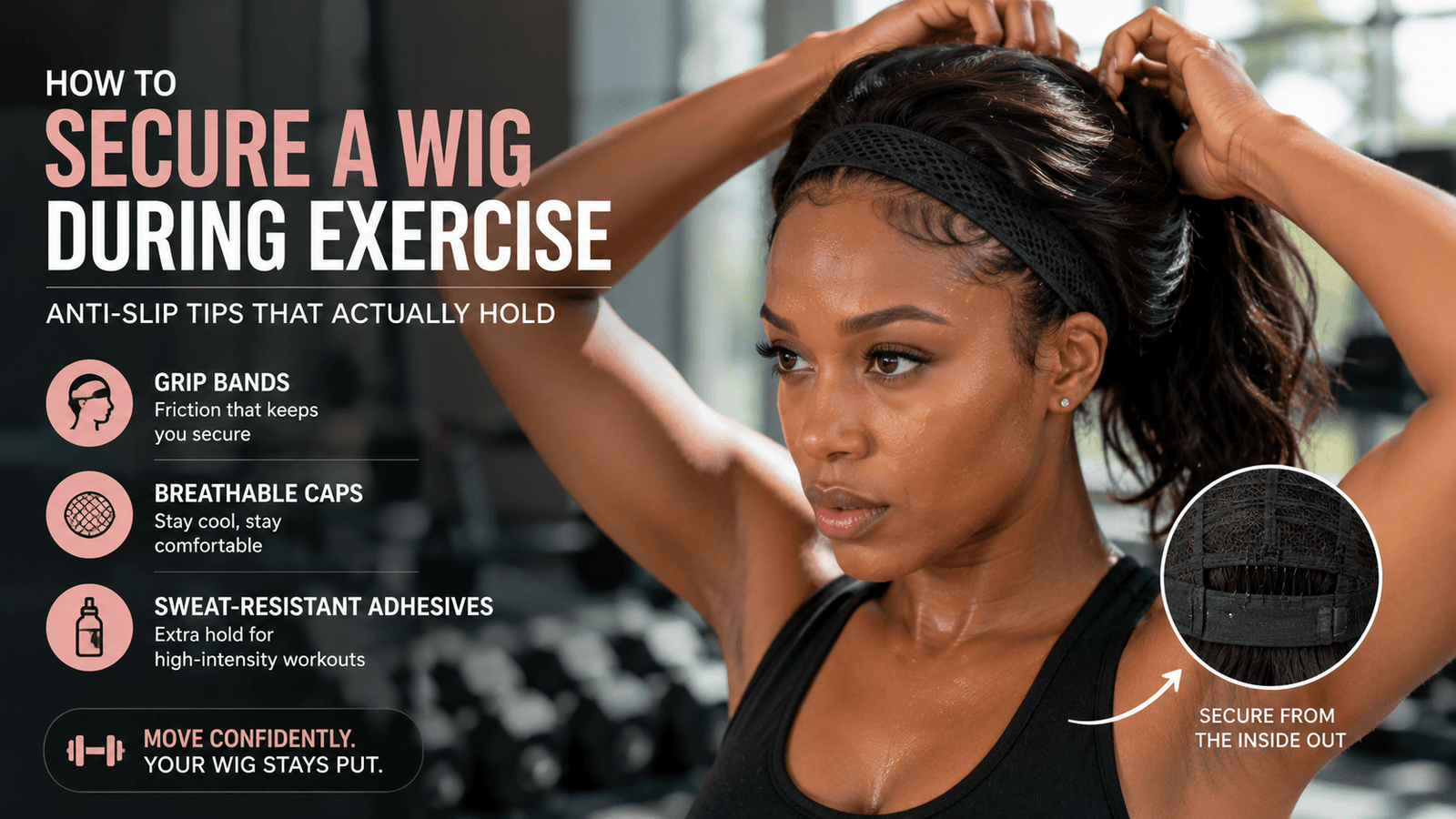
To keep a wig from slipping during exercise, you need three things working together: a velvet wig grip band against your scalp, a breathable cap that doesn't trap sweat, and a style choice that matches your workout intensity. Adhesive alone won't save you, sweat breaks down most glues within 15 minutes of cardio. But layer these three elements, and your wig stays put through anything short of swimming.
What if the wig you're wearing right now could survive a HIIT class without budging, not because of the glue you used, but because of what's inside the cap? Most wig wearers reach for more adhesive when their wig slips. But the real fix starts with understanding why wigs shift during movement in the first place, and that answer has more to do with cap construction than most people realize.
You already know the frustration: you're 10 minutes into a run, your hairline feels damp, and suddenly you're adjusting your wig instead of focusing on your pace. It's distracting, it's embarrassing, and if you're a salon owner whose clients complain about this exact problem, it's costing you repeat business.
By the end of this article, you'll know exactly which anti-slip methods work for each type of workout, what cap features actually prevent shifting (from a manufacturing perspective), and how to choose, or stock, wigs that stay secure no matter how hard you train.
Key Takeaways - A velvet wig grip band is the single highest-impact purchase, it creates friction without glue and works for every workout type - Cap construction matters more than adhesive: open-weft Swiss lace caps breathe better and trap less sweat than closed-weft HD lace, reducing the "greenhouse effect" that lifts your wig - Match your hold method to your sweat level: grip band for yoga, grip + tape for HIIT, grip + tape + pins for sports - Higher-density wigs (180%+) weigh more and shift more during movement, a 150% density wig is 25-30% lighter and noticeably more stable for exercise - When sourcing wigs for active clients, specify silicone grip zones at the crown and nape, 4-strap adjustable systems, and pre-attached combs
Why Wigs Slip During Exercise, And Why More Glue Isn't the Answer
Maria runs a small salon in Miami. One of her best clients, a fitness instructor, came back three weeks after buying a 180% density lace front wig and said it wouldn't stay put during her spin classes. Maria's first instinct was to recommend a stronger adhesive.
The client tried Ghost Bond. Still slipped. Tried Bold Hold Active. Same result, just took 10 minutes longer.
The problem wasn't the glue. It was the wig itself.
Three forces work against your wig during exercise:
-
Sweat acts as a solvent. The salts and oils in perspiration break down water-based adhesives on contact. Even waterproof formulas weaken as body heat rises.
-
Momentum creates shear force. When you run, jump, or bend, your wig is subject to the same physics as everything else on your body. A 180% density wig can weigh 200g or more, that mass generates real pulling force with every stride.
-
Heat loosens elastic. The internal bands and straps that grip your head are temperature-sensitive. After 15 minutes of elevated body heat, they lose tension.
The "greenhouse effect" is what connects these three forces. A closed-weft cap traps body heat and moisture against your scalp. That trapped heat loosens your wig's elastic. That trapped moisture dissolves your adhesive.
The result: your wig lifts at the hairline first, then the nape, and suddenly you're holding your head still while the rest of you is doing burpees.
The Physics of a Slipping Wig
Here's something most wig retailers won't mention: density affects stability. A 200% density wig contains roughly 50% more hair by weight than a 130% density wig. More mass means more momentum. More momentum means more force pulling against whatever is holding the wig down.
For exercise, lighter is more stable. This is physics, not opinion.
The nape lifts first because that's where friction is lowest, there's no forehead ledge at the back of your head. The wig's weight pulls it forward during movement, and the back edge has nothing to brace against. This is why the "security stack" approach we cover later prioritizes nape anchoring.
Wig Grip Bands: Start Here Before Anything Else
If you take one thing from this article, make it a velvet wig grip band. Not silicone. Not a "wig grip spray." A velvet wig grip band.
David runs an e-commerce wig store. He started including a free velvet grip band with every order in January 2026. By March, his return rate for "fit issues" dropped 18%.
The cost per band was $0.80 at wholesale. The average return was costing him $12 in shipping and restocking.
Here's why grip bands work: they increase the coefficient of friction between your scalp and the wig cap. Velvet grips create a surface that hair doesn't slide across easily. Silicone grips use tackiness for the same purpose. Both work, but for different scenarios.
Velvet vs Silicone Grip Bands, Which for Your Workout?
| Feature | Velvet Grip Band | Silicone Grip Band |
|---|---|---|
| Hold mechanism | High friction surface | Tacky grip |
| Breathability | Excellent, fabric breathes | Moderate, silicone doesn't |
| Sweat handling | Absorbs moisture | Repels moisture (waterproof) |
| Best for | Yoga, Pilates, weight training, daily wear | HIIT, running, heavy sweating |
| Comfort for long wear | Very comfortable | Can feel tight after 2+ hours |
| Durability | 3-6 months with regular washing | 6-12 months |
| Price (retail) | $5-15 | $8-20 |
For most people, start with velvet. It's more comfortable, handles moderate sweat well, and costs less. Add a silicone grip if you do high-intensity cardio regularly or live in a humid climate.
How to Position a Wig Grip Band
The "four-finger rule" gets the placement right every time: place your pinky at your brow bone. Where your index finger lands is where the front edge of the grip band should sit. The band should cover your entire hairline and extend to the nape of your neck.
Layer in this order: scalp → grip band → wig cap → wig. The grip band sits directly against your skin so it has something to grip. Putting it on top of the wig cap defeats the purpose.
Pro Tip: If you use adhesive, apply it AFTER the grip band and wig cap. The adhesive goes between the wig cap and the wig lace, not between the grip band and the cap. This keeps the grip band clean and reusable.
Exercise-Ready Wig Construction: What to Look for When Sourcing
Now we get into what makes Voretrade different: we actually know how wigs are built. Most articles tell you to "get a breathable wig" without explaining what that means at the manufacturing level. Here's what it actually means.
Lace Types and Breathability
When you're sweating through a workout, the air permeability of your wig's lace directly affects how fast moisture builds up underneath.
| Lace Type | Breathability | Durability | Best Exercise Use |
|---|---|---|---|
| Swiss lace | Highest, larger holes, thinner threads | Moderate (6-12 months) | Daily gym wear, cardio |
| HD lace | Low, ultrafine mesh, minimal airflow | Low (3-6 months) | Low-sweat activities only |
| Regular lace | Medium | High (12+ months) | Versatile, durable option |
Swiss lace breathes better because the thread weight is lighter and the hole structure is more open. This isn't marketing, it's a physical property of the material. Under a microscope, Swiss lace shows a grid pattern with roughly 30-40% more open area than HD lace of the same dimensions.
For exercise, Swiss lace is the clear winner. HD lace may look slightly more invisible, but that thinness comes at the cost of airflow, and airflow is what keeps your wig from floating on a layer of sweat.
Cap Materials That Fight Moisture
Open-weft caps offer roughly 40% better airflow than closed-weft caps. In an open-weft cap, the hair is sewn onto strips of material with gaps between them, heat and moisture escape through the gaps. In a closed-weft cap, the entire inner surface is one solid piece of material.
Bamboo wig liners are worth mentioning as a supplemental layer. Bamboo is naturally antibacterial and wicks moisture away from skin. Worn between your scalp and the grip band, it adds a sweat-absorbing layer that extends how long you can exercise before moisture becomes a problem.
Anti-Slip Features to Specify When Ordering
If you're a salon owner or e-commerce seller ordering wigs for active clients, these are the construction features to ask your supplier for:
- 4-strap adjustable system (not 2-strap): Four anchor points distribute tension more evenly and hold better during movement
- Silicone grip zones at crown and nape: Small silicone strips sewn into the cap interior that grip your scalp or grip band
- Pre-attached combs at temples and back: These dig into the grip band or wig cap for mechanical anchoring
- Elasticized edges with silicone beading: The entire perimeter of the cap has a slight tension and tackiness
- Open-weft cap base with Swiss lace front: Maximum breathability where it matters most
Any factory that knows wigs can include these features. The cost difference is minimal, usually $1-3 per unit at wholesale. If your current supplier can't or won't specify these details, our team can help you find a factory that will.
The Security Stack: Layering Your Hold by Activity
Think of wig security like dressing for cold weather: one layer works for a cool day. For a blizzard, you stack multiple layers. Same principle applies here.
Layer 1: Flat Foundation (Every Workout)
Start with cornrows or flat pin-curls, never a bulky bun. Bumps create pressure points. Pressure points become pivot points. Pivot points let the wig rock back and forth with every step.
Layer 2: Moisture Barrier (Sweaty Workouts)
A moisture-wicking headband or bamboo wig liner worn under the grip band catches sweat before it reaches the wig cap. This is the difference between a 20-minute secure hold and a 60-minute secure hold for heavy sweaters.
Layer 3: Friction (Every Workout)
Your velvet or silicone wig grip band. This is non-negotiable.
Layer 4: Adhesive (High-Impact Workouts)
Sweat-resistant tape at the hairline and temples. Apply in thin layers, let each dry tacky before placing the lace. For heavy sweating, Ghost Bond Platinum and Bold Hold Active are the two products that consistently hold up in real-world testing.
Layer 5: Mechanical Anchors (Sports and Performance)
Bobby pins or U-pins inserted through the wig cap into the grip band at temples and nape. These are backup, they catch the wig if everything else fails.
Here's how this stacks up by activity:
| Activity | Sweat Level | Layers Needed | Estimated Hold Time |
|---|---|---|---|
| Yoga / Pilates | Low | 1 + 2 + 3 | 2+ hours |
| Weight training | Low-Medium | 1 + 2 + 3 | 1.5-2 hours |
| Running (moderate) | Medium | 1 + 2 + 3 + 4 | 1-1.5 hours |
| HIIT / CrossFit | High | 1 + 2 + 3 + 4 | 45-60 minutes |
| Dance class | Medium-High | 1 + 2 + 3 + 4 + 5 | 1+ hour |
| Team sports | High | 1 + 2 + 3 + 4 + 5 | 45-60 minutes |
For swimmers, the rules change entirely. A waterproof silicone adhesive plus a swim cap over the wig is the only combination that works. Rinse the wig with fresh water immediately after swimming, chlorine and salt water are equally damaging to both human hair and synthetic fibers.
Best Wig Styles for Exercise by Activity
The wig style matters as much as how you secure it. Some styles are naturally more stable.
Headband wigs are the top choice for HIIT and running. No lace means no adhesive to fail. The built-in headband absorbs sweat and creates a continuous grip surface around the entire head. They slip on in 10 seconds and stay put for a full workout.
Short pixie cuts and bobs work well because less length means less weight and less momentum. A 10-inch bob can weigh 40% less than a 22-inch straight style, that's 40% less force trying to pull the wig off during movement.
Low ponytail and braided wigs keep hair contained in a single unit that doesn't bounce. The key word is "low", high ponytails create use at the nape of the neck. Every time you run, the ponytail swings like a pendulum, prying the back edge of your wig away from your skin.
Glueless lace wigs with combs and adjustable straps offer a good middle ground: natural-looking hairline without relying on sweat-vulnerable adhesive.
Avoid these for exercise: full lace wigs with no combs (nothing to anchor them), 200%+ density wigs over 22 inches (too much weight and motion), and any wig you've had installed for more than a week with the same adhesive (the bond has already degraded).
Post-Workout Care: Make Your Wig Last
Sweat doesn't just make wigs slip, it damages them. Salt crystals abrade the hair fiber. Moisture breeds bacteria on the cap. Heat degrades the elastic.
Immediate after-workout routine: Blot, don't rub. Pat sweat off the hairline and nape with a microfiber towel. Rubbing creates tangles, especially in human hair wigs where the cuticles catch on each other.
The cool-shot dryer trick: if your adhesive turned white or cloudy from sweat, run a blow dryer on cool setting over the hairline for 10-15 minutes. The adhesive re-cures as it cools and turns clear again. No reapplication needed.
Cleaning schedule: For heavy sweaters, rinse the wig with cool water every 6-8 wears. Deep wash with wig shampoo every 12-15 wears. Between washes, dry shampoo or wig refresher spray absorbs residual moisture and eliminates odor.
Storage: Always air-dry on a wig stand. Never store a damp wig, that's how you get mildew in the cap and musty-smelling hair. A silk or satin wrap overnight keeps the style intact and prevents friction damage on your pillow.
If you use adhesives, clean the residue from the lace with 99% isopropyl alcohol after every 2-3 wears. Built-up adhesive blocks the lace holes and reduces breathability, which brings us right back to the greenhouse effect.
For Business Buyers: Stocking Exercise-Friendly Wigs
If you sell wigs, your active customers are silently asking for this. They may not use the words "anti-slip" or "exercise-friendly", they say things like "it kept slipping off" or "it didn't fit right." But behind those return reasons is often the same core problem: the wig wasn't built for movement.
What Active Customers Actually Need
Jasmine started a wig boutique on Shopify six months ago. Her first batch of 50 units was 180% density HD lace wigs, beautiful, photogenic, exactly what Instagram influencers were showing. Three months in, she had an 18% return rate. The number one reason customers gave: "doesn't stay in place."
She adjusted her second order: 70% Swiss lace, 130-150% density, open-weft caps, 4-strap adjustable systems, pre-attached combs. Her return rate dropped to 7%.
Her product descriptions now highlight "secure 4-point fit" and "breathable open-weft cap", terms her customers didn't know to ask for, but immediately understood the value of.
The wig features that reduce returns aren't the ones that look good in photos. They're the ones you can't see: the cap construction, the strap system, the breathability, the weight distribution. These are the specs worth asking your supplier about.
Wig Specs to Prioritize for Active Clientele
When you're placing a wholesale order, specify these exactly:
- Density: 130-150% for exercise-friendly wigs. Lighter wigs move less and trap less heat.
- Lace type: Swiss lace front for breathability. Reserve HD lace for special-occasion styles.
- Cap: Open-weft construction with 4-strap adjustable system.
- Additional features: Silicone grip zones, pre-attached combs (3 minimum), elasticized edges.
- Hair origin: Chinese and Brazilian hair hold curl better in humidity than Indian hair, relevant if your customers exercise outdoors.
These specs add roughly $2-5 per unit at wholesale, depending on the factory. The return rate reduction alone pays for it many times over. A 10% return rate improvement on a 100-unit order at $45 wholesale means $450 saved, and that's before accounting for the customer lifetime value of buyers who don't return their first purchase.
If you're sourcing from Chinese factories and want help specifying these features in terms the factory understands, read our supplier vetting guide or reach out directly. We apply these same construction standards to every wig we source for buyers.
Frequently Asked Questions
Can I wear a lace front wig to the gym?
Yes, but use a grip band underneath and opt for sweat-resistant tape rather than water-based glue. Avoid working out within 24 hours of a fresh adhesive install, adhesives need curing time. For regular gym-goers, a glueless lace front with combs and straps is more practical than a bonded install.
Will sweat ruin my human hair wig?
Sweat won't ruin human hair immediately, but accumulated salt and oil will degrade the hair over time if not washed out. Human hair wigs used for exercise need to be washed more frequently, every 8-10 wears minimum. Synthetic wigs are more sweat-tolerant but still need rinsing to prevent cap odor.
What's the best wig grip for heavy sweating?
A silicone-lined grip band outperforms velvet for heavy sweating because silicone is waterproof. The Milano WiGrip and the velvet grips with silicone backing strips (hybrid designs) are the most commonly recommended options tested across multiple workout types.
How tight should my wig be for exercise?
Snug, not tight. You should be able to slide one finger under the band at your temple. If you feel a headache developing within 30 minutes, it's too tight, and too-tight wigs actually shift more because they can't absorb movement flex.
Does wig density affect how well it stays on during a workout?
Yes, significantly. Higher density wigs are heavier. A 200% density 22-inch wig can weigh 50% more than a 150% density version. That extra weight generates more momentum during movement, which means more force pulling the wig off your head.
What's the best wig type for running?
Headband wigs are the best for running because they eliminate lace and adhesive entirely. The built-in headband absorbs sweat and creates friction around your whole head. Short bobs under 14 inches with a grip band underneath are a close second.
How do I stop my wig from lifting at the nape during yoga inversions?
Insert two bobby pins in an X formation at the nape of your neck, going through the wig cap into your grip band underneath. The X pattern creates a mechanical lock that holds during positions where gravity pulls the wig away from your neck.
Your Wig Shouldn't Dictate Your Workout
A wig that slips during exercise isn't a "wig problem", it's a construction and method problem. Once you understand the three forces working against you (sweat as solvent, momentum as shear, heat as elastic-loosener) and counter each one (friction grip, lighter density, breathable cap), the issue disappears.
Start with the velvet grip band. If that's not enough, add a moisture-wicking liner underneath. Still not enough? Layer sweat-resistant tape at the hairline and temples.
The "security stack" approach means you adjust your hold to your activity, not the other way around.
And if you're buying wigs to sell: the exercise-friendly features your customers need are invisible in product photos but obvious in product performance.
Specify the cap construction. Lower the density. Add the silicone grips. Your return rate will tell you it was worth it.
Need help sourcing wigs built for active lifestyles? We supply buyers with wigs spec'd to the features covered in this article, open-weft caps, Swiss lace, adjustable systems, silicone grip zones. WhatsApp us at +86 17347350405 or email hello@voretrade.com to discuss your requirements.
Whether you browse our products or tell us what you need custom-sourced, you'll get the same 4-step verification process on every order, so what you approve is what arrives.