Human Hair vs Synthetic Hair: Complete Wig Comparison 2026
May 25, 2026 · Marcus Vore
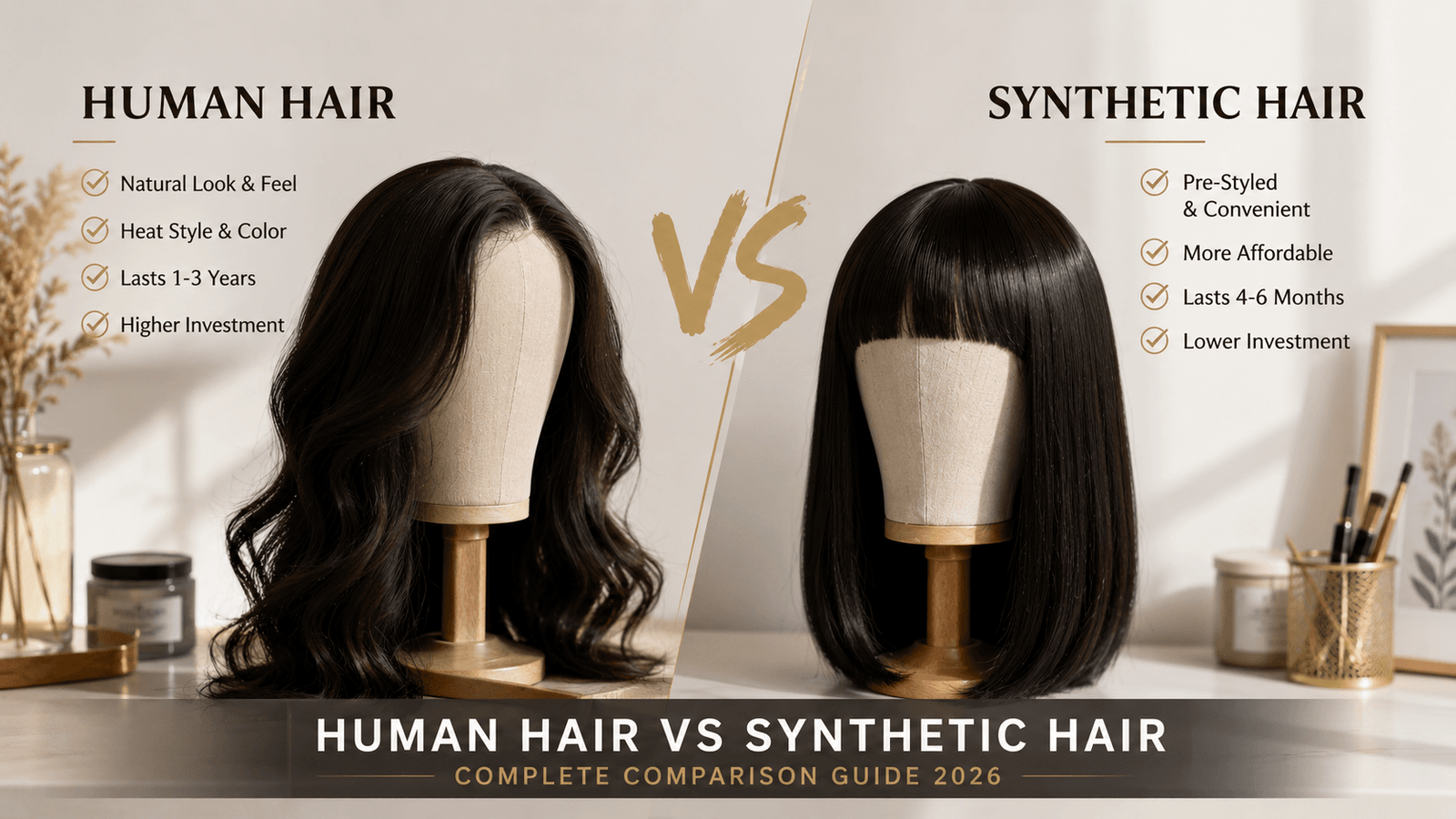
The core difference between human hair and synthetic hair wigs comes down to three things: lifespan, styling versatility, and cost. Human hair wigs last 1-3 years, accept heat styling and coloring, and cost 3-5x more at wholesale. Synthetic wigs last 4-6 months with daily wear, hold their style without effort, and free up significantly less working capital per unit. Neither is universally better. The right choice depends on your end customer, your price point, and your business model.
If you're sourcing wigs from China for resale, this decision affects everything from your margins to your return rate. Stock the wrong type for your market and you'll either tie up capital in slow-moving inventory or deal with returns from disappointed customers.
This guide covers both the product knowledge (what each type actually is, how they perform, how to verify quality) and the business intelligence (which to stock, margin analysis, inventory strategy). Whether you're buying for yourself or building a wig business, you'll know exactly what you're getting and why.
Key Takeaways - Human hair wigs last 1-3 years with proper care; synthetic lasts 4-6 months with daily wear - Human hair commands a 3-5x wholesale premium over synthetic, but also delivers higher retail margins - 65.6% of the global wig market by revenue is human hair (Grand View Research, 2025) - For business buyers: human hair has higher margins but more capital risk; synthetic moves faster with lower per-unit investment - The biggest quality risk in sourcing: synthetic or processed hair sold as "virgin human hair", verify with burn test and cuticle check before committing to bulk
What is human hair and what is synthetic hair?
Before comparing performance, it helps to understand what you're actually buying. The terms "human hair" and "synthetic hair" each cover a range of quality levels, and the differences within each category can be as significant as the differences between them.
Human hair types: virgin, Remy, and processed
Virgin hair is the highest grade. It means the hair was collected from a single donor, the cuticles are aligned in one direction (root to tip), and it has never been chemically treated. This is what commands premium pricing and delivers the longest lifespan.
Remy hair is cuticle-aligned human hair that may come from multiple donors and may have undergone minimal processing (such as color standardization). It's a step below virgin in quality but still performs well for 12-18 months.
Processed human hair has been chemically treated to achieve a uniform color or texture. The processing weakens the hair structure, reducing lifespan to 6-12 months. It's the most affordable human hair option but also the most likely to tangle and shed over time.
Synthetic fiber types: Kanekalon, Toyokalon, and Futura
Not all synthetic hair is the same. The fiber type determines how natural it looks, how it handles heat, and how long it lasts.
Kanekalon is the most common synthetic fiber. It's a modacrylic fiber with a natural-looking sheen, good curl retention, and low heat tolerance (melts above 150°C). Most budget synthetic wigs use Kanekalon or similar fibers.
Toyokalon is softer and lighter than Kanekalon, with a slightly more natural feel. It's popular in braiding hair and mid-range synthetic wigs.
Futura is a heat-friendly polyester fiber developed by Kanekalon that withstands temperatures up to 180°C. It can be styled with flat irons and curling wands, bridging the gap between synthetic convenience and human hair versatility. Futura-based wigs cost more than standard synthetic but significantly less than human hair.
The "human hair blend" category
Some wigs mix human hair with synthetic fibers (typically 70/30 or 50/50 ratios). These blends aim to offer some styling versatility at a lower price point than pure human hair. The trade-off: they can't be colored, heat tolerance is limited, and lifespan falls between the two categories (8-14 months typical).
For business buyers, blends occupy an awkward middle ground. They're harder to market clearly and can confuse customers who expect either full human hair performance or synthetic pricing.
Human hair vs synthetic hair: side-by-side comparison
Understanding the human hair wig pros and cons alongside synthetic wig trade-offs helps you make a decision based on facts, not marketing claims. This table summarizes the key differences. Below it, we break down each factor in detail.
| Factor | Human hair | Synthetic hair |
|---|---|---|
| Appearance | Natural movement, shine, and texture | Can look natural (high-end) or obviously artificial (budget) |
| Feel | Soft, behaves like natural hair | Varies by fiber; Futura feels closest to human hair |
| Heat styling | Full heat tolerance (flat iron, curling wand, blow dry) | Standard: no heat. Heat-friendly (Futura): up to 180°C |
| Coloring | Can be dyed, bleached, toned | Cannot be colored with traditional hair dye |
| Lifespan (daily wear) | 1-3 years (virgin), 6-12 months (processed) | 4-6 months (standard), 6-10 months (premium) |
| Maintenance | Requires washing, conditioning, styling (like natural hair) | Minimal; holds pre-set style, wash every 2-3 weeks |
| Weight | Heavier, especially at high density | Lighter, more comfortable for extended wear |
| Wholesale cost (China) | $40-120 per unit (varies by grade, length, construction) | $8-30 per unit |
| Retail price range | $150-3,000+ | $30-300 |
| Return rate | Lower (when quality matches description) | Higher for budget options; lower for premium synthetic |
Natural appearance and feel
Human hair wins on realism. It moves, reflects light, and responds to humidity the way natural hair does. For customers who need an undetectable wig (medical hair loss, daily wear, professional settings), human hair is the standard.
That said, premium synthetic technology has improved significantly. High-end synthetic wigs using Futura or similar fibers can fool most people at conversational distance. The difference becomes obvious under close inspection or when styling with heat.
Styling versatility
Human hair accepts any styling tool and technique: flat irons, curling wands, blow dryers, rollers, and chemical coloring. This makes it ideal for customers who change their look frequently or need salon-level customization.
Standard synthetic holds one pre-set style permanently. This is actually an advantage for customers who want a wash-and-go experience with zero styling effort. Heat-friendly synthetic (Futura fiber) offers a middle ground, accepting low-heat styling up to 180°C.
Lifespan and durability
With proper care, a virgin human hair wig lasts 1-3 years of regular wear. According to Keswigs, premium virgin hair lace fronts can last 3-5 years with occasional wear.
Synthetic wig lifespan is significantly shorter: 4-6 months with daily wear, or up to 12 months with rotation and careful handling. The fibers degrade from friction, heat exposure (even body heat), and washing. Once a synthetic wig starts frizzing at the ends, it can't be restored.
For business buyers, this lifespan difference affects your repeat purchase rate. Human hair customers buy less frequently but spend more per purchase. Synthetic customers buy more often at lower price points.
Maintenance requirements
Human hair requires the same care as natural hair: regular washing with sulfate-free shampoo, deep conditioning, heat protectant before styling, and proper storage on a wig stand. Customers who neglect maintenance will see their wig degrade faster, which can lead to complaints.
Synthetic wigs need minimal care: occasional washing with cool water and wig-specific products, air drying on a stand, and gentle detangling. The pre-set style returns after washing without any effort. For busy customers or those new to wigs, this low maintenance is a genuine selling point.
The real cost breakdown: human hair vs synthetic
Price is the first thing most buyers compare. But the sticker price doesn't tell the full story. What matters for your business is cost-per-wear and total margin after returns.
Retail price ranges
End consumers typically pay: - Synthetic wigs: $30-300 depending on fiber quality, cap construction, and brand - Human hair wigs: $150-3,000+ depending on hair grade, length, density, and lace type
The gap is real. A customer can buy three to four synthetic wigs for the price of one mid-range human hair wig.
Wholesale price ranges from China
At factory-direct pricing from Chinese manufacturers, the numbers look different: - Synthetic wigs: $8-30 per unit (standard Kanekalon lace front in 14-22 inch lengths) - Human hair wigs (processed): $40-65 per unit - Human hair wigs (Remy): $55-90 per unit - Human hair wigs (virgin): $75-120+ per unit
These ranges assume standard MOQs (Minimum Order Quantities). Smaller orders cost more per unit. Longer lengths, higher densities, and premium lace types (HD lace) add to the base price.
For context on total landed cost including shipping from China and duties, see our guide to import duties and taxes.
Cost-per-wear: the metric that actually matters
A $200 human hair wig worn daily for 18 months costs $0.37 per wear. A $60 synthetic wig worn daily for 5 months costs $0.40 per wear. The "expensive" option is actually cheaper per use.
For business buyers, this translates to customer lifetime value. A customer who buys one $200 human hair wig and comes back 18 months later for another represents $400 over 3 years. A customer who buys a $60 synthetic wig every 5 months represents $432 over 3 years, but across 7 transactions with 7 opportunities for them to switch to a competitor.
Neither model is wrong. They serve different business strategies.
How to tell real human hair from synthetic (quality verification)
This is where sourcing from China gets risky. The most expensive mistake isn't choosing the wrong wig type. It's paying human hair prices for synthetic fiber, or paying virgin hair prices for heavily processed hair.
We've seen it happen: a buyer orders 50 units of "100% virgin human hair" at $65 per unit. The wigs arrive looking acceptable. They sell 20 units. Within three weeks, customers report tangling, matting, and an unnatural sheen after washing. The "virgin hair" was actually processed synthetic blend with a silicone coating that washed out.
That's $3,250 in inventory, plus refunds, plus damaged reviews. Here's how to prevent it.
The burn test
Cut 5-10 strands from an inconspicuous area. Light them with a match.
- Real human hair: Burns slowly, curls into ash, smells like burning protein (similar to burning fingernails). Ash crumbles when touched.
- Synthetic fiber: Melts quickly into a hard plastic bead, smells like burning plastic. Residue is hard and shiny.
- Blended: Mixed behavior. Some strands ash, some melt. This means the supplier is mixing fibers.
The bleach test
Apply a small amount of hair bleach to a few strands.
- Real human hair: Lightens in color within 15-30 minutes
- Synthetic fiber: No color change whatsoever
Cuticle direction check
Run your fingers from tip to root (against the natural direction). On cuticle-aligned human hair, you'll feel slight resistance. On synthetic or non-Remy hair, it feels the same in both directions.
What to ask your supplier before ordering
- "Can you send a video of the shed test (10 brush strokes) on my specific product?"
- "Can you provide photos of the hair both dry and wet?"
- "What is the hair origin and grade? Single donor or mixed?"
- "Will you do a burn test on camera?"
A supplier who welcomes these requests is one worth working with. A supplier who deflects or makes excuses is telling you something. For more on evaluating suppliers, read our guide on how to find reliable suppliers in China.
Which wig type should you stock? (For business buyers)
The global wig market was valued at USD 2.68 billion in 2025, with human hair accounting for 65.6% of market share by revenue. But revenue share doesn't mean unit share. Synthetic wigs sell in far higher volumes at lower price points. Both segments are growing.
The right inventory mix depends on your business model, target customer, and available capital.
Salon owners: what your clients actually want
Salon clients typically want human hair. They're paying for a professional fitting and styling service, and they expect premium product to match. A salon that stocks only synthetic risks looking budget-oriented.
Recommended mix: 70% human hair (Remy and virgin), 20% premium synthetic (Futura fiber), 10% standard synthetic (for clients who want affordable fashion options).
Stock human hair in your most-requested lengths and textures. Keep a few premium synthetic options for clients who want variety without the investment, or for protective styling between appointments.
E-commerce sellers: inventory strategy by price point
Online, you're competing on product listings and reviews. Your strategy depends on your price positioning:
Budget store ($30-80 retail): Stock 80-100% synthetic. Your customers are price-sensitive and buying for variety, not longevity. Focus on trendy styles, colors, and fast shipping. Keep MOQs low and rotate styles frequently.
Mid-range store ($80-250 retail): Stock 50% human hair (processed and Remy), 30% premium synthetic, 20% standard synthetic. This gives you price points for different customer segments and lets you upsell.
Premium store ($200+ retail): Stock 80-100% human hair (Remy and virgin). Your customers expect quality and are willing to pay. Invest in detailed product photography and education content that justifies the price.
Distributors: margin analysis and return rate considerations
For distributors selling to salons and retailers, consider:
- Human hair margin: 40-60% markup from wholesale to distributor price. Higher absolute margin per unit but more capital tied up.
- Synthetic margin: 50-80% markup. Lower absolute margin per unit but faster inventory turnover and less capital risk.
- Return rates: Human hair returns typically run 3-5% (mostly sizing or color mismatch). Budget synthetic returns run 8-15% (quality complaints, doesn't match photos). Premium synthetic returns are comparable to human hair at 4-6%.
The mixed inventory approach
Most successful wig businesses stock both types. The ratio varies by market, but the principle is consistent: human hair builds your reputation for quality; synthetic drives volume and introduces new customers who may upgrade later.
A first-time buyer who starts with a $40 synthetic wig and has a good experience is a future $200 human hair customer. Give them a reason to come back.
When to choose human hair
Human hair is the right choice when:
- Daily wear and longevity matter: Customers who wear a wig every day need something that lasts. The cost-per-wear math favors human hair for daily wearers.
- Styling versatility is required: Customers who want to curl, straighten, color, or restyle their wig need human hair. No synthetic (even heat-friendly) matches this flexibility.
- Natural appearance is critical: For medical hair loss, professional settings, or customers who need their wig to be completely undetectable, human hair is the standard.
- Your market is premium-positioned: If you're selling to quality-conscious buyers who research before purchasing, human hair builds trust and justifies premium pricing.
Best markets: Premium salons, bridal and special occasion, medical and alopecia specialists, luxury e-commerce.
When to choose synthetic
Synthetic is the right choice when:
- Low maintenance is the priority: Customers who want to put on a wig and go, without washing, conditioning, or styling, are better served by synthetic. The pre-set style is a feature, not a limitation.
- Fashion variety matters more than longevity: Customers who want multiple looks (different colors, lengths, styles) without spending $200+ per wig are synthetic buyers.
- Budget is the primary constraint: For price-sensitive markets or customers testing wigs for the first time, synthetic removes the financial barrier to entry.
- Your business model is volume-based: If you're selling through marketplaces, social media, or impulse-purchase channels, synthetic's lower price point converts more browsers into buyers.
Best markets: Fashion and trend-driven retail, protective styling, costume and cosplay, budget-conscious consumers, first-time wig buyers.
Frequently asked questions
How long does a human hair wig last compared to synthetic?
Human hair wigs last 1-3 years with daily wear and proper maintenance (regular washing, conditioning, and careful storage). Virgin hair at the top of that range, processed hair at the bottom. Synthetic wigs last 4-6 months with daily wear, or up to 12 months with occasional use and rotation. The difference comes down to fiber structure: human hair can be repaired and reconditioned, while synthetic fibers degrade irreversibly from friction and heat.
Can you tell the difference between human hair and synthetic by looking?
At a distance, premium synthetic wigs (especially those using Futura fiber) can look convincingly natural. Up close, the differences become apparent: human hair has natural variation in strand thickness and subtle imperfections, while synthetic fibers are perfectly uniform. The most reliable visual tell is how the hair moves. Human hair swings and settles naturally; synthetic tends to bounce back to its set shape.
Is it worth paying more for a human hair wig?
For daily wearers, yes. The cost-per-wear is comparable or lower than synthetic when you factor in the longer lifespan. For occasional wear (events, fashion variety, protective styling), synthetic offers better value because you're not utilizing the longevity advantage of human hair. For business buyers, "worth it" depends on your target market's willingness to pay and your desired margin structure.
Can synthetic wigs be styled with heat tools?
Standard synthetic (Kanekalon, Toyokalon) cannot. Heat will melt the fibers permanently. Heat-friendly synthetic (Futura and similar fibers) can be styled with tools set below 180°C (356°F). This allows basic curling and straightening but not the full range of styling that human hair accepts. You cannot color or bleach any synthetic fiber.
What is the best wig type for a new wig business?
Start with a mix. Stock 60-70% of your inventory in the type that matches your target market's primary need (human hair for premium positioning, synthetic for volume/budget positioning), and 30-40% in the other type to capture adjacent demand. Order samples in both before committing to bulk. Track which sells faster and which generates fewer returns, then adjust your ratio based on real data from your specific market.
How do I verify that a supplier is selling real human hair?
Three tests: burn test (real hair turns to ash and smells like protein; synthetic melts into a bead and smells like plastic), bleach test (real hair lightens; synthetic doesn't change), and cuticle check (run fingers tip-to-root; real cuticle-aligned hair feels different in each direction). Always test samples before placing bulk orders. A reliable supplier will perform these tests on video without hesitation.
Making your decision
Neither human hair nor synthetic is universally "better." They serve different customers, different price points, and different business models. The right choice depends on who you're selling to and what they value most.
If you're sourcing wigs from China, the quality verification step matters more than the hair type decision. A well-made synthetic wig from a reliable factory will outperform a poorly-made "human hair" wig from a dishonest supplier every time.
Whatever you choose to stock, verify before you commit. Order samples. Test them yourself. Ask the hard questions. The suppliers who welcome scrutiny are the ones worth building a relationship with.
Need help choosing the right hair type for your market, or want verified samples of both human hair and synthetic options? We source both categories with the same 4-step quality verification process, and we're happy to advise on inventory mix based on what we see working for buyers in your market.
- WhatsApp: +86 17347350405
- Email: hello@voretrade.com
No commitment needed. Just a conversation about what works for your business.