Human Hair vs. Synthetic Wigs: Which One Should You Stock for Your Customers?
June 6, 2026 · Marcus Vore
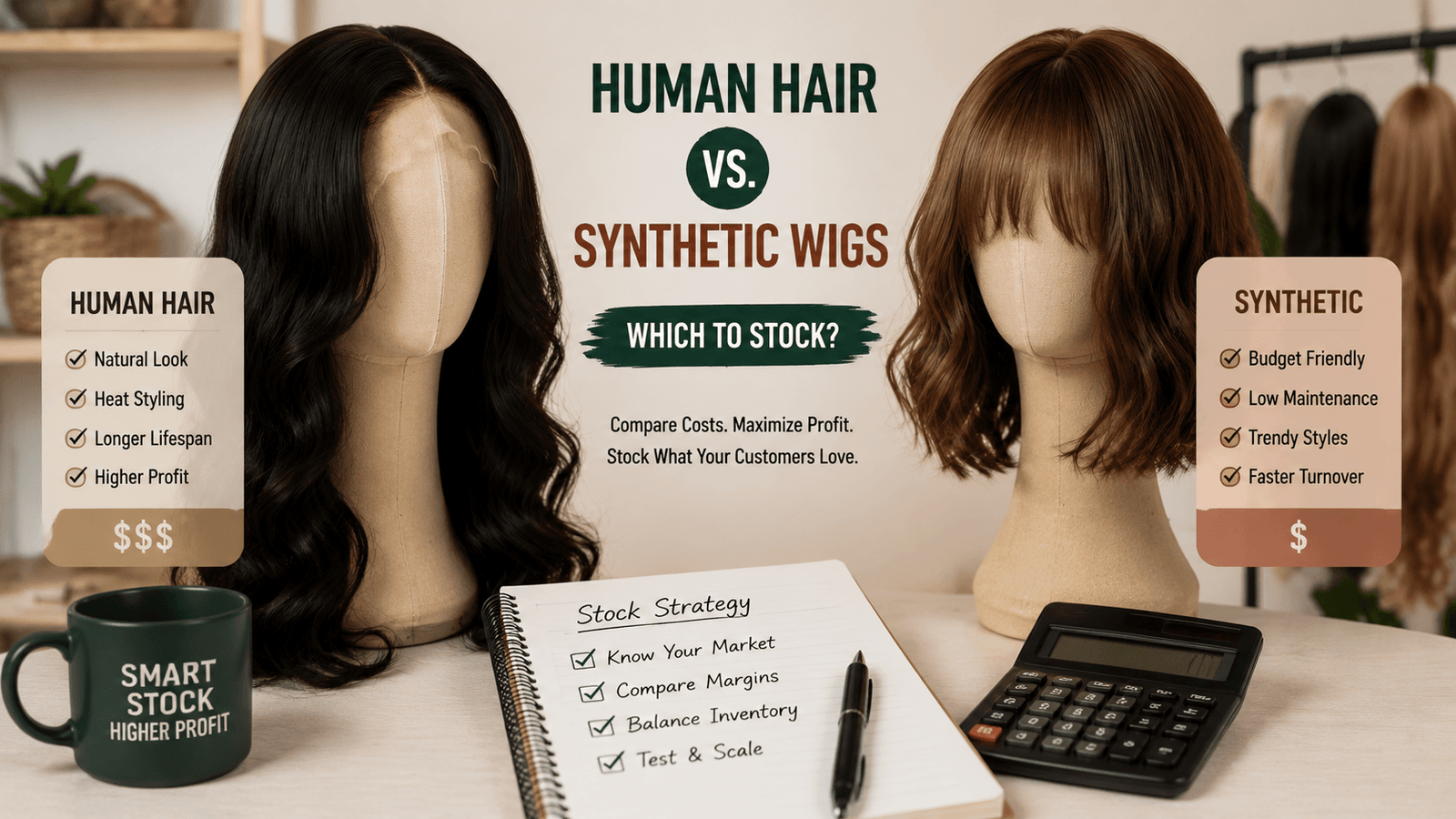
If you're starting a wig business, stock both human hair and synthetic, but allocate 60-70% of your first inventory budget to synthetic and 30-40% to human hair. This mix protects your cash flow while letting you test which type your specific customers actually buy. Synthetic turns inventory faster and requires less upfront capital. Human hair delivers higher profit per unit but ties up more cash. The right ratio depends on your business model, which we'll break down below.
When Priya launched her online wig store in March 2025, she went all-in on human hair. She spent $4,200 on 70 units, virgin Brazilian lace fronts, 150% density, every texture she could find. "Human hair is what sells," she told herself. "That's where the margins are."
Six weeks later, she'd sold 11 units. The remaining 59 sat in her spare bedroom, representing $3,500 in frozen cash. Meanwhile, her competitor two towns over stocked a $1,200 mix of heat-friendly synthetic and a few human hair pieces, and sold through her entire inventory in the same six weeks, then reordered.
The lesson isn't that Priya chose wrong. It's that she chose without a framework.
Key Takeaways - Human hair wigs generate $80-$430 profit per unit but require $1,500-$3,500 in capital for a starter order of 50 pieces - Synthetic wigs turn inventory 2-3x faster with less than half the upfront investment, ideal for new businesses testing the market - 62% of consumers say they prefer human hair, but synthetic is the fastest-growing segment at 10.2% CAGR, driven by heat-friendly fiber technology - The most profitable sellers stock BOTH: human hair for premium buyers seeking natural looks, synthetic for trend-driven and entry-price customers - Your biggest inventory risk isn't choosing the "wrong" type, it's paying human hair prices for synthetic. We'll show you how to verify every unit
Human Hair vs. Synthetic Wigs: The Real Differences That Affect Your Inventory
Before you decide what to stock, you need to understand what you're buying, and what your customers will experience after they pay you.
What Makes Human Hair Wigs Different
Human hair wigs come in three grades, and the differences directly determine your return rate.
Virgin hair comes from a single donor, with cuticles aligned in one direction. This alignment prevents tangling and extends lifespan to 12-36 months with proper care. Virgin hair accepts heat styling up to 400°F, can be bleached and dyed, and looks natural under any lighting. At wholesale, virgin hair costs $40-$70 per unit for a 13x4 or 13x6 lace front wig with 150-180% density.
Remy hair also has aligned cuticles but may come from multiple donors. It's still real human hair with good longevity (8-18 months), and most customers can't tell the difference from virgin. Wholesale pricing runs $28-$45 per unit, the most common choice for mid-range inventory.
Non-Remy hair is the category that generates returns. The cuticles are not aligned, which means the hair tangles and mats after a few washes. Some suppliers chemically strip the cuticles and coat the hair in silicone to hide the damage. The wig looks beautiful in the package. After 3-5 washes, the coating strips off and the real hair underneath reveals itself, dry, tangled, and shedding. Non-Remy wholesale runs $15-$25 per unit. The margin looks attractive. The return rate will erase it.
What Synthetic Wigs Are Made Of
Synthetic wigs use engineered fibers, not real hair. The quality of those fibers determines everything about how the wig looks, feels, and wears.
Standard synthetic (Kanekalon, Toyokalon): These are the workhorses of the synthetic category. Pre-styled, zero maintenance, shake-and-wear. They cannot take heat, a curling iron at any temperature will melt the fiber. Lifespan is 3-6 months with daily wear. Wholesale: $5-$15 per unit. These sell fastest at the entry price point.
Heat-friendly synthetic (Futura fiber): This is the technology closing the gap with human hair. Futura fiber withstands heat up to 356°F (180°C), which means customers can curl, straighten, and restyle. It has a matte finish that eliminates the plastic shine of older synthetics. Lifespan is 4-8 months with daily wear. Wholesale: $15-$25 per unit for a lace front. This is the fastest-growing synthetic category in 2026.
The practical difference for your business: A customer who buys a standard synthetic for $49 retail expects 3-4 months of wear and won't complain. A customer who buys a $120 heat-friendly synthetic expects it to behave like human hair, and will return it if it doesn't. Price your synthetics clearly and set expectations in your product descriptions.
The Hybrid Category, What "Human Hair Blend" Actually Means
Some suppliers sell "human hair blend" wigs. What this almost always means: 70-80% synthetic fiber mixed with 20-30% processed human hair. The human hair component adds some natural movement and reduces shine. The synthetic component holds the style and keeps costs down.
Hybrid wholesale pricing runs $18-$30 per unit. Retail positioning is tricky; you can't sell it as human hair (it isn't), and calling it "blend" signals lower quality than 100% human hair. Most successful sellers skip this category entirely and offer a clear good/better/best ladder instead.
Cost and Profit: What Each Type Means for Your Bottom Line
This is where most stocking advice falls apart, it talks about retail prices without showing you the wholesale numbers that determine whether your business actually makes money.
Wholesale Pricing Reality (FOB China, 2026)
Here's what you'll actually pay when ordering from a Xuchang factory. These are FOB prices, shipping, duties, and customs clearance are additional.
| Wig Type | Wholesale Unit Cost | MOQ for Best Price | First Order Capital (50 units) |
|---|---|---|---|
| Standard synthetic lace front | $8-$15 | 50-100 pcs | $400-$750 |
| Heat-friendly synthetic (Futura) with HD lace | $18-$28 | 30-80 pcs | $900-$1,400 |
| Remy human hair 13x4 lace front (150% density) | $28-$45 | 50-100 pcs | $1,400-$2,250 |
| Virgin human hair 13x6 HD lace (180% density) | $48-$56 | 50-100 pcs | $2,400-$2,800 |
| Custom/OEM full lace virgin human hair | $40-$70 | 30-50 pcs | $2,000-$3,500 |
One thing that surprises first-time buyers: Xuchang factories are typically 20-30% cheaper than trading companies in Guangzhou or coastal cities. You're buying closer to the source. But you'll need to manage the supplier relationship directly, which is where a sourcing partner who already has vetted factory relationships saves you time and risk.
The Margin Math That Matters
Gross margin percentages look similar across wig types, 60-85% is standard. But the dollar profit per unit tells a different story.
Marcus runs a six-figure Amazon wig store. He stocks three tiers:
- Entry: Standard synthetic at $12 wholesale, sells for $45 retail = $33 gross profit per unit. He sells 40-60 units per month. Low margin dollars, high velocity.
- Mid: Heat-friendly synthetic at $22 wholesale, sells for $95 retail = $73 gross profit per unit. He sells 25-35 units per month. The sweet spot for volume AND profit.
- Premium: Virgin human hair at $50 wholesale, sells for $220 retail = $170 gross profit per unit. He sells 8-12 units per month. Highest profit per sale, slowest turns.
His monthly gross profit: roughly $2,700 from entry synthetic + $2,200 from mid-tier + $1,700 from premium = $6,600 total. If he only stocked human hair, his monthly profit would be closer to $2,500; and he'd have $8,000+ tied up in slow-moving inventory.
The takeaway: synthetic generates cash flow. Human hair generates margin. You need both.
Hidden Costs That Eat Your Margin
Return rates. Human hair wigs sourced from reliable factories have a 5-10% return rate, and returns are rarely resellable (worn, styled, sometimes washed). Synthetic wigs return at 8-15%, with "looks fake" and "shinier than expected" as the top reasons. Heat-friendly synthetics return at 12-18% because customers don't follow heat settings and damage the fiber, then blame the product.
Every return costs you the refund plus shipping plus a unit you can't resell. If you sell 100 units at $100 average and have a 12% return rate, that's $1,200 in lost revenue, before you factor in the negative reviews that suppress future sales.
Customer support load. Human hair buyers ask more pre-purchase questions (density, origin, care instructions) but fewer post-purchase complaints. Synthetic buyers ask fewer questions upfront but lodge more "this doesn't look like the photo" complaints. Budget 30% more support time for synthetic inventory, or write better product descriptions that set accurate expectations.
Need help calculating your landed cost with shipping and duties? Our complete guide to import duties and taxes walks through every line item.
Which Wig Type Fits Your Business Model?
The right stocking decision starts with your specific business, not with which wig type is "better."
Salon Owners
Your clients walk in, sit in your chair, and expect to walk out transformed. They trust your recommendation. If you put them in a synthetic wig that looks artificial under salon lighting, they won't complain, they'll just find a different salon.
Stock: 70% human hair (mix of virgin and Remy), 30% heat-friendly synthetic for clients who want a temporary style change or are price-testing before committing to human hair.
Prioritize: HD lace fronts, 150-180% density, textures that match your local demographic. Salon clients pay for installation and expect the result to last.
E-Commerce Sellers (Amazon, Shopify, TikTok Shop)
Online buyers can't touch the hair before purchasing. They rely on photos, reviews, and price signals. This creates two dynamics: synthetic sells well at the entry price because the risk feels low, and human hair sells at premium prices because detailed product photos show the quality difference.
Stock: 50% heat-friendly synthetic, 30% Remy human hair, 20% virgin human hair. Start synthetic-heavy and shift toward human hair as you build reviews and repeat customers.
Prioritize: Glueless ready-to-wear styles, the fastest-growing B2B category in 2026. Online buyers want "put it on and go." Include density and lace type in every product title. Amazon customers who understand what they're buying return products 40% less often.
Boutique Retailers
Your foot traffic is lower than online, but your conversion rate is higher. Customers who walk into a boutique expect a curated experience. They'll pay more but they'll also inspect more carefully.
Stock: 60% Remy human hair, 25% heat-friendly synthetic, 15% virgin human hair. Keep SKU count low (8-12 styles) and depth shallow (2-3 units per style). Reorder what sells.
Prioritize: Display-quality packaging. In a boutique, the unboxing happens at the counter. Make it feel premium.
Distributors and Wholesalers
Your buyers are other businesses. They care about consistency batch-to-batch, reliable restock timelines, and margin.
Stock: 60% human hair (Remy is the volume play), 40% synthetic. Distributors need both because their customers, retailers and salons, need both.
Prioritize: Supplier relationships, not specific products. Your business runs on predictable quality and on-time delivery. Vet your factory partners carefully, one bad batch can cost you five wholesale customers.
Private Label Brands
You're building a brand, not just moving units. Your reputation attaches to every wig that ships with your logo on the box.
Stock: Start with 80% Remy human hair, 20% heat-friendly synthetic. Human hair builds brand credibility. Synthetic fills out the catalog at lower price points. Once your brand has traction, decide whether you're a premium-only brand or a full-spectrum brand.
Prioritize: Custom packaging and consistent quality. Your second order needs to match your first order exactly. Document your specs, density, lace type, hair origin, construction method, and verify against those specs on every shipment. Learn more about our 4-step verification process and how it protects brand consistency.
The Customer Profile Matrix, Matching Wig Type to Buyer
Beyond your business model, your customer base determines what sells.
Premium buyers want natural movement, heat styling freedom, and invisible lace. They'll spend $180-$400 per wig and expect 12+ months of wear. They research before buying. Stock human hair for this segment, they'll return synthetic every time.
Convenience buyers want grab-and-go. They don't own a curling iron and don't want to learn how to install a lace front. Stock pre-styled synthetic and glueless human hair options. Price point: $40-$120.
First-time wig buyers are nervous. They don't know what density means. They're afraid of looking "wiggy." Stock heat-friendly synthetic at $50-$90, low enough commitment that they'll try it, good enough quality that they'll come back for their second wig.
Medical and hair loss clients have specific needs they may not articulate upfront. They want comfort (lightweight cap, no irritation), security (won't slip off), and realism (they don't want anyone to know). Stock both types but prioritize soft-cap construction and natural hairlines over density or styling versatility. Price sensitivity varies widely, offer options at multiple price points.
The Smart Inventory Strategy, How to Build Your First Order
The Good/Better/Best Price Ladder
Every successful wig seller uses this structure:
| Tier | Product | Wholesale Cost | Retail Price | Gross Profit |
|---|---|---|---|---|
| Good | Standard synthetic lace front | $10-$15 | $35-$60 | $25-$45 |
| Better | Heat-friendly synthetic with HD lace | $18-$28 | $75-$120 | $57-$92 |
| Best | Remy/virgin human hair lace front | $35-$55 | $140-$280 | $105-$225 |
This ladder does three things: it gives entry buyers a low-risk option, it creates an obvious upgrade path, and it anchors your premium pricing. Customers who see the Best option first perceive Better as "reasonable" rather than "expensive."
Recommended First Order by Budget
$1,000 starting budget: - 40 standard synthetic units (4-5 styles, multiple colors) = ~$500 - 15 heat-friendly synthetic units (2-3 styles) = ~$350 - Use the remaining $150 for product photography and packaging
$3,000 starting budget: - 40 heat-friendly synthetic units (4-5 styles) = ~$900 - 30 Remy human hair units (3-4 styles, focus on 150% density) = ~$1,200 - 15 standard synthetic units (trend colors/styles) = ~$200 - Remaining $700: samples of virgin hair for future expansion, photography, branded packaging
$10,000+ starting budget: - 60 Remy human hair units (6-8 styles, multiple densities) = ~$2,400 - 50 heat-friendly synthetic units (5-6 styles) = ~$1,200 - 30 virgin human hair units (3-4 premium styles) = ~$1,600 - 30 standard synthetic (fast-turn trend pieces) = ~$400 - Remaining $4,400: custom packaging, professional product photography, website/shop setup, shipping supplies, sample library for future orders
Test Before You Commit
Before dropping $5,000 on a single wig type:
- Order 3-5 samples in each category you're considering (different textures, densities, lace types)
- Show them to 10 potential customers, friends, family, existing clients if you have them. Ask: "Would you pay $X for this?" Watch their face when they say yes or no.
- List the samples online at your intended retail price. If they sell, you have a market signal. If they sit, you just saved yourself a bad bulk order.
- Track which questions buyers ask. If everyone asks "is this human hair?", your market wants human hair. If the first question is always "what's the price?", your market is price-sensitive and synthetic-heavy.
The cost of sampling, maybe $200-$400, is the cheapest insurance you'll ever buy against a $5,000 inventory mistake.
How to Verify You're Getting What You Paid For
Carlos ordered 100 units of "100% virgin human hair" from a new supplier at $32 per unit, about 30% below the typical Xuchang factory price. The samples looked fine. The bulk order arrived and the hair felt... different. A burn test revealed the truth: the supplier had mixed synthetic fiber into the wefts, roughly 30% synthetic to 70% processed human hair. Carlos couldn't sell the units as human hair. He couldn't return them. His $3,200 "savings" cost him $3,200 in dead inventory plus the customers who never came back.
This happens every day. Here's how to make sure it doesn't happen to you.
The Burn Test: Cut 5-10 strands from an inconspicuous area. Hold with tweezers, light with a match. Real human hair burns slowly, curls into ash, smells like burning protein (similar to burning fingernails or hair from a hairbrush). Synthetic melts instantly into a hard plastic bead and smells like burning plastic. If you see both ash AND melted beads, the wig contains a synthetic blend. Do this test on every sample order and on random units from every bulk shipment.
The Bleach Test: Dip a small strand in hair bleach. Virgin human hair lifts to a warm orange or yellow tone within 15-20 minutes. Heavily processed human hair lifts unevenly or breaks down. Synthetic fiber doesn't lift at all, the bleach has zero effect. This test also reveals whether "virgin" hair has actually been chemically processed.
The Cuticle Check: Run your fingers down a strand of hair from root to tip. Smooth. Now run them from tip to root. Slightly rough or resistant. That's the cuticle layer, it only exists on real human hair. Synthetic fiber feels the same in both directions. If the hair feels identical root-to-tip and tip-to-root, it's synthetic.
Pre-shipment inspection is non-negotiable. Before you pay the balance on any bulk order, your supplier should send detailed photos and videos of your actual products, not samples, not a previous batch, but your specific units. If a supplier won't do this, find one who will. For more on vetting suppliers, read our guide on how to find reliable suppliers in China.
Frequently Asked Questions
Which is more profitable, human hair or synthetic wigs?
Synthetic wigs deliver faster cash flow (2-3x inventory turnover) with lower per-unit profit ($25-$92 gross profit). Human hair delivers higher per-unit profit ($105-$225 gross profit) with slower turns. The most profitable approach is stocking both, synthetic generates operating cash while human hair builds margin. Most successful sellers allocate 50-60% of inventory budget to synthetic and 40-50% to human hair.
How much capital do I need to start a wig business?
A workable starter inventory costs $1,000-$3,000 for a synthetic-heavy mix (40-70 units across 6-10 styles). A balanced human hair + synthetic inventory needs $3,000-$5,000. A premium human hair-only boutique needs $5,000-$10,000. Start smaller than you think, you can always reorder. You can't un-order dead inventory.
What type of wigs sell fastest online?
Heat-friendly synthetic glueless wigs are the fastest-turning category in 2026, particularly on TikTok Shop and Amazon. They hit the $50-$90 retail sweet spot where buyers feel comfortable purchasing without touching the product first. Human hair wigs sell slower but generate higher revenue per transaction and better repeat customer rates.
Can I start with synthetic and add human hair later?
Yes, and this is the path most successful sellers take. Start synthetic to generate cash flow and learn your market's preferences. Use the data from your first 3-6 months (which styles sell, what customers ask for, what gets returned) to inform your first human hair order. The sellers who struggle are the ones who go all-in on human hair before they know what their market wants.
How do I know a supplier is selling real human hair?
Request a burn test on video. Ask for photos of the hair both dry and wet. Order samples and perform all three verification tests yourself (burn, bleach, cuticle check). A legitimate supplier will welcome these requests. A supplier who makes excuses is telling you something. Also: if the price is 30%+ below the typical Xuchang factory price for the claimed quality level, it's not that quality level.
What's the minimum order for wholesale human hair wigs?
Most Xuchang factories set MOQ at 50-100 pieces for best wholesale pricing. Many will accept 20-30 pieces with a $3-$7 per-unit surcharge. Some mid-size factories and trading companies offer MOQs as low as 5-10 pieces for first-time buyers. True wholesale pricing, the numbers in this article, typically kicks in at 50+ pieces. For more on logistics, see our complete guide to shipping from China.
What are the most popular wig types for e-commerce in 2026?
Glueless ready-to-wear lace front wigs lead the category across both human hair and synthetic. 13x4 and 13x6 lace fronts dominate. Body wave and loose wave textures outsell straight 3-to-1 online. 150% and 180% density are the most searched terms in wig product titles. HD lace is the standard for anything positioned above $100 retail.
How do returns compare between human hair and synthetic wigs?
Human hair sourced from reliable factories returns at 5-10%. Heat-friendly synthetic returns at 12-18% (mostly from customers damaging the fiber with incorrect heat settings). Standard synthetic returns at 8-15% (mostly "looks fake" complaints). The best way to reduce returns across all types: set accurate expectations in your product descriptions and include clear care instructions with every order.
Build the Inventory Mix That Works for Your Market
The question isn't "human hair or synthetic?" It's "what ratio of each makes my business profitable?"
Start with synthetic for cash flow. Add human hair for margin. Use your first 3-6 months of sales data to adjust the ratio. The sellers who win aren't the ones who pick the "right" wig type, they're the ones who listen to their market and stock accordingly.
Most importantly, verify quality at every step. The biggest threat to your wig business isn't stocking the wrong type. It's stocking the right type at the wrong quality level, and discovering it through customer returns instead of pre-shipment inspection.
Need help sourcing verified human hair or synthetic wigs at wholesale prices? We'll help you plan your first order based on your target market, budget, and business model. Reach us on WhatsApp at +86 17347350405 for a free consultation, or email hello@voretrade.com with your requirements. No commitment, just a conversation about what will work for your specific business.