The Wholesale Buyer's Handbook to Wig Density, Texture, and Color Codes
June 6, 2026 · Marcus Vore
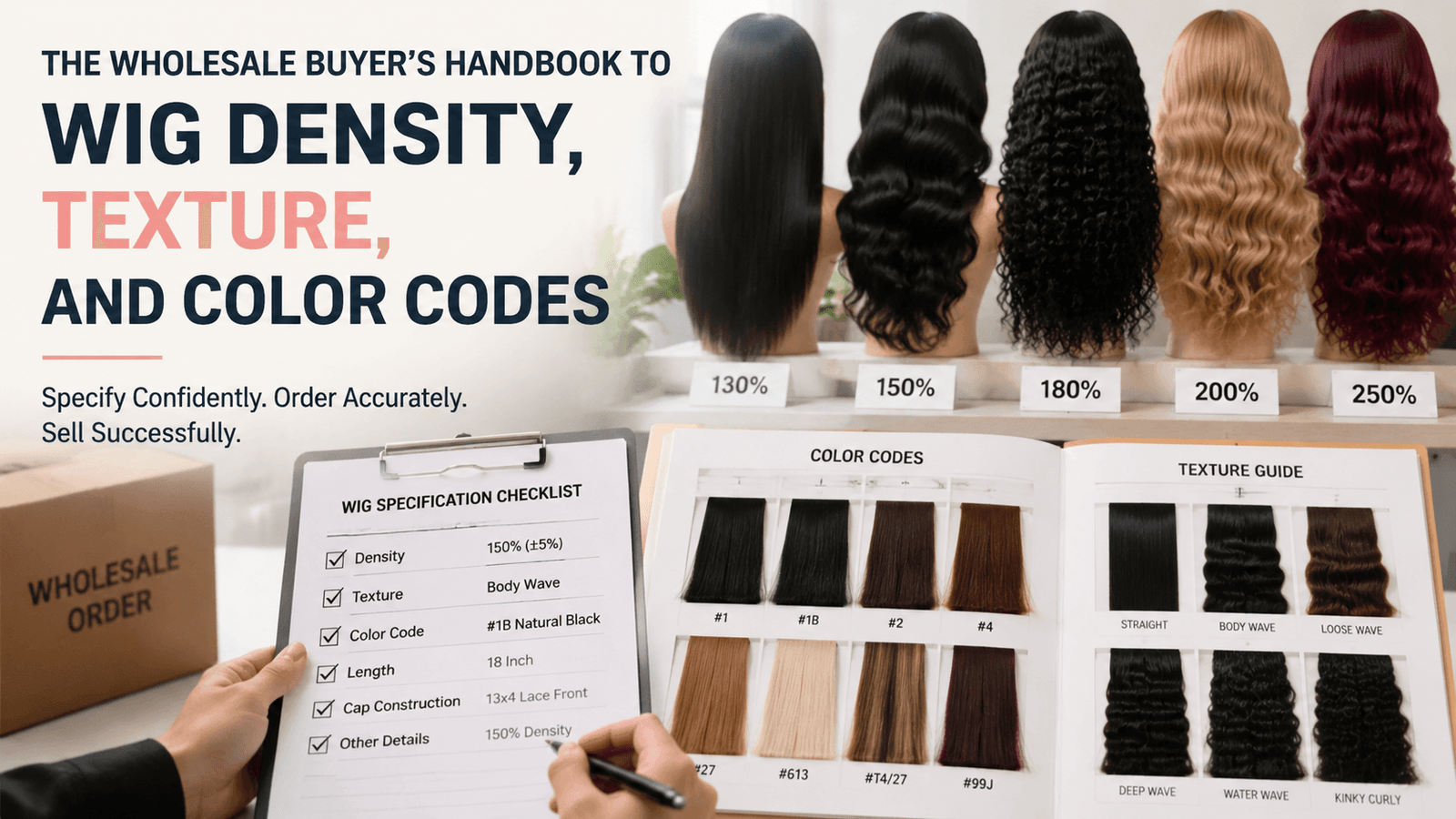
The three specs that determine whether your wig inventory sells or sits are density (how full it looks), texture (the curl pattern), and color code (the exact shade). Get any one of them wrong for your market, and you're buying returns. Get all three right, and you have a repeatable wholesale business. This wig hair density guide walks you through all three specs, teaching you to specify each one like a professional buyer, verify what you received, and avoid the mismatches that cost wholesale buyers thousands in dead inventory.
Key Takeaways - 150% density in body wave texture with color #1B is the lowest-return-risk combination across most global markets - Density affects your unit cost by $3-15 per piece at wholesale, ordering "maximum density" when your market wants natural looks wastes margin on hair your customers don't want - A "golden sample" (physical reference unit approved by both you and the supplier) is the only reliable way to lock color consistency across reorders, written codes alone aren't enough - Curly textures create 30-40% more visual volume than straight at the same density percentage, a 130% deep wave looks as full as a 180% straight wig - Never write "medium density black body wave" on an RFQ. Write "150% density (±5%), #1B natural black (neutral undertone), body wave (loose S-pattern, 1-inch wave spacing)"
Wig Density Explained: What the Percentages Actually Mean
Wig density is the amount of hair attached per square inch of the wig cap, expressed as a percentage of an average natural head of hair. 100% represents roughly 100-120 strands per square inch, what you'd find on a typical person's head. Every percentage above that adds proportionally more hair.
For wholesale buyers, density isn't just an aesthetic choice. It's a cost driver. A 200% density wig uses roughly 50% more raw hair than a 130% density wig of the same length. That's real material cost, not markup.
The Density Scale: From 50% to 250%
| Density | Strands/sq in | Visual Appearance | Wholesale Cost Impact | Best Application |
|---|---|---|---|---|
| 50-80% | 60-100 | Very light, scalp often visible | Lowest | Medical wigs, older clients, extreme realism |
| 100-120% | 100-130 | Light, natural, airy | Base price | Everyday natural look, hot climates |
| 130% | 130-150 | Natural medium, most common | Standard | General market, safest wholesale choice |
| 150% | 150-180 | Full, noticeable volume | +$2-3/unit | Most popular wholesale SKU globally |
| 180% | 180-220 | Glamorous, high volume | +$5-7/unit | Social media, younger market, special occasions |
| 200% | 220-260 | Dramatic, very full | +$7-10/unit | African/Caribbean markets, drag, performance |
| 250%+ | 260+ | Maximum volume | +$10-15/unit | Specialty, specific cultural preferences |
The price difference is raw material cost, not arbitrary markup. More hair costs more to source, process, and ventilate onto the cap. Factor this into your margin calculations, a 250% density wig at the same retail price as a 150% density wig is eating 10-15% of your margin on materials alone. And since import duties are calculated on your total invoice value, higher density orders also mean higher duty payments on arrival.
How Density Interacts with Length and Texture
Density doesn't operate in isolation. Two factors change what density you actually need:
Length: Longer wigs need higher density to avoid looking thin at the ends. A 12-inch bob at 130% density looks full and premium. A 28-inch straight wig at 130% will look stringy and see-through from mid-length down. The rule of thumb: add 20% density for every 8-10 inches of additional length beyond 14 inches.
Texture: Curly and wavy textures create natural volume that makes lower density percentages look fuller. A 130% density deep wave wig has roughly the same visual fullness as a 180% density straight wig. This matters because it directly affects your cost, you can stock lower density percentages in curly textures without sacrificing the full look your customers expect.
Density by Market: What Sells Where
Your target market determines your density mix more than any other factor. Here's what moves in each region:
US General Market: 150% is the volume driver. Stock 60% of inventory at 150%, 30% at 180%, 10% at 130%. The 180% segment is growing; social media is pushing demand for fuller looks.
European Market: 130-150% dominates. European customers tend to prefer natural, understated density. A 200% density wig in this market often gets returned as "obviously a wig." Stock 50% at 130%, 40% at 150%, 10% at 180%.
African & Caribbean Markets: 180% is the floor, 200-250% is the volume zone. This is a cultural expectation, not a preference, wigs perceived as "too thin" get returned. Stock 30% at 180%, 50% at 200%, 20% at 250%.
E-Commerce / Mixed Audience: Stock 40% at 150%, 30% at 180%, 20% at 130%, 10% at 200%. List density prominently in product titles and descriptions, buyers who understand density convert at higher rates and return less.
Need help figuring out the right density mix for your specific market? Tell us your target customers and we'll recommend a breakdown based on what's working for similar buyers. WhatsApp us →
Hair Texture Types: Matching Texture to Your Customer Base
Texture, the curl pattern or wave of the hair, is the second spec that determines whether your inventory moves. Different textures serve different customer segments, have different maintenance requirements, and interact differently with density and color.
The Complete Texture Reference for Wholesale Buyers
| Texture | Visual Description | Shrinkage Factor | Best Density Match | Maintenance Level | Top Markets |
|---|---|---|---|---|---|
| Straight | Sleek, polished, zero wave | None | 150-180% (needs higher density for fullness) | Low | Europe, professional wear, heat-styling customers |
| Body Wave | Loose S-pattern, natural movement | 5-10% | 130-150% | Low-Medium | Global volume leader, broadest market appeal |
| Loose Wave | Soft romantic waves, more definition than body wave | 10-15% | 130-150% | Medium | US salon, e-commerce, bridal |
| Water Wave | Defined "wet look" crimp pattern | 15-20% | 130-150% | Medium | African markets, tropical climates, fashion |
| Deep Wave | Tight S-pattern, significant volume | 20-30% | 130-150% | Medium-High | US beauty supply, Caribbean, glamour segment |
| Jerry Curl | Small defined ringlets | 30-40% | 120-150% | High | Retro styles, specialty, African markets |
| Kinky Straight | Textured with micro-crimp, mimics blown-out natural hair | 10-15% | 130-150% | Medium | African American market, texture-matching |
| Kinky Curly / Coily | Tight coils, 4A-4C pattern | 40-50% | 150-200% | High | Natural hair community, African/Caribbean |
| Yaki (Light/Regular/Coarse) | Relaxed or pressed texture, micro-kinks | 5-10% | 130-150% | Low-Medium | Professional wear, texture-blending |
Body wave is the global volume leader for a reason: it's versatile enough to style straight or enhance the wave, forgiving on density (looks good from 130-180%), and has the broadest cross-market appeal. If you're launching a wholesale wig line with only one texture, start with body wave.
Texture Mistakes That Drive Returns
When Marcus started his online wig store in Atlanta, he ordered 50 units of "kinky straight" from a new supplier in Guangzhou. The samples looked perfect, textured, natural, exactly what his customers wanted. The bulk order arrived with a completely different crimp pattern. The supplier's "kinky straight" was their standard straight hair with a light texturizing spray that washed out after the first shampoo.
Marcus lost $2,400 on that order, and worse, his customers posted reviews about "fake texture" that followed his store for months. This is exactly the kind of situation that proper supplier vetting prevents. If you're still figuring out how to find reliable suppliers in China, start with a structured verification process before committing to bulk orders.
Three texture traps that catch wholesale buyers:
"Kinky straight" means different things to different factories. Some factories produce genuine textured hair with the crimp baked into the strand. Others apply a temporary texturizing treatment that washes out. Always specify: "Permanent kinky straight texture that survives 5+ washes without pattern loss."
Curly textures appear 3-4 inches shorter than straight hair of the same labeled length. If you list a 22-inch deep wave wig without noting that it hangs at 18-19 inches due to the curl pattern, expect returns from customers who measure and find it short.
Texture consistency depends on donor origin. A factory that sources hair from multiple regions will produce slightly different body wave patterns depending on whether the donor hair is Indian (naturally wavy, holds pattern well) or Chinese (straighter, requires more processing to hold wave). If texture consistency matters for your brand, and it should, ask your supplier to commit to a single donor region per SKU.
Wig Color Codes Decoded: The Numbers System Every Buyer Must Know
The wig industry uses a standardized 1-10 numbering system where lower numbers are darker and higher numbers are lighter. Letters and compound codes indicate tones, highlights, and rooted effects. It's simple in theory. In practice, a "#1B" from one factory can look noticeably different from a "#1B" from another.
The Standard Color Code Reference
| Code | Name | Undertone | Wholesale Volume | Notes |
|---|---|---|---|---|
| #1 | Jet Black | Cool, blue-black | Medium | Looks dyed on most skin tones, limits your customer base |
| #1B | Natural Black / Off-Black | Neutral to slightly warm | Highest volume globally | The universal volume driver, stock this in every order |
| #2 | Darkest Brown | Warm, subtle brown | High | Visible brown undertone in sunlight; often confused with #1B online |
| #4 | Dark Brown | Warm, medium brown | High | Versatile; works across most markets |
| #6 | Medium Brown | Neutral to warm | Medium | Good second color option for European markets |
| #8 | Light Ash Brown | Cool, ash | Low-Medium | Niche; popular in European/Nordic markets |
| #27 | Honey Blonde | Warm, golden | Medium | Top-selling blonde for African American market |
| #30 | Medium Auburn | Warm, red-brown | Low-Medium | Niche; popular in autumn/winter seasonal collections |
| #33 | Dark Auburn | Deep red-brown | Low-Medium | Pairs well with #1B for rooted/ombre styles |
| #613 | Platinum Blonde | Can range from ash to golden | High | Pre-bleached, requires virgin-grade donor hair or it tangles and sheds |
| #350 | Dark Brown with Red | Warm red undertone | Low-Medium | Popular for ombre and highlight combinations |
The #1B vs #1 vs #2 Problem
This is the most common color confusion in wholesale wig buying. Here's the practical reality:
#1 (Jet Black) looks unnatural on most skin tones. It photographs as a flat, inky black with no dimension. For markets where "natural-looking" matters (Europe, US general market, Australia), #1 limits your addressable customer base.
#1B (Natural Black / Off-Black) is the global volume leader. It has subtle brown undertones that read as "natural dark hair" rather than "dyed black." It photographs with dimension. It works across the widest range of skin tones and markets. If you stock only one color, stock #1B.
#2 (Darkest Brown) is the trouble color. It looks almost identical to #1B in product photography, especially under studio lighting, but noticeably lighter in person. Buyers who think they're getting "soft black" open the box to find brown hair. This is one of the top color-related return drivers in wholesale.
The fix: if you stock both #1B and #2, photograph them side by side in natural daylight in your product listings. The visual contrast reduces returns by setting accurate expectations.
Color Consistency: How to Prevent Shade Drift Between Orders
Sarah runs a salon chain in London. Her first order of #1B body wave wigs from a Xuchang factory was perfect, rich natural black with a neutral undertone, exactly what her clients wanted. The reorder three months later arrived with a noticeably warmer, reddish undertone. Same SKU, same supplier, different dye lot. Her clients noticed. Five returns in the first week.
The problem isn't that Sarah's supplier did anything dishonest. It's that hair dye lots vary, and without a physical reference standard, "1B natural black" is open to interpretation.
Three things that prevent shade drift:
Lock a golden sample. Approve one physical unit as your color reference. Both you and the supplier keep one, labeled and dated. Every future batch gets compared to the golden sample, not to a memory of what the last batch looked like.
Require batch-level color photos before shipment. Ask for photos of 3-5 random units from your production batch, photographed in daylight against a white background with your golden sample in the frame. If the batch doesn't match, catch it before it ships.
Define your undertone tolerance in writing. "#1B natural black" isn't enough. Write: "#1B natural black, neutral undertone (no red/warm shift), acceptable tolerance within 1 shade level as measured against [reference color ring standard]." This gives you something objective to point to if a batch arrives off-color.
Getting burned by inconsistent color between orders? We retain golden samples for every buyer and check every batch against them before shipment. See how our verification process works →
How Density, Texture, and Color Interact (and Why It Matters for Returns)
Most wholesale buyers treat density, texture, and color as three separate decisions. They're not. These three specs form a system where each choice affects the others, and certain combinations are return-rate disasters waiting to happen.
The Interaction Matrix
| Density | Texture | Color | Result | Return Risk |
|---|---|---|---|---|
| 130% | Straight | #1B | Natural, lightweight everyday look | Low |
| 150% | Body Wave | #1B | Full, natural, most versatile | Lowest |
| 150% | Body Wave | #613 | Full, processed blonde | Medium (processing damage risk) |
| 180% | Straight | #1 | Very full, unnatural black, looks wiggy | Medium-High |
| 180% | Deep Wave | #1B | Glamorous, high volume | Low-Medium |
| 180% | Straight | #613 | High density + processed color = elevated shedding | High |
| 200% | Kinky Curly | #4 | Very full, curl adds more visual volume, may look bulky | Medium |
| 130% | Deep Wave | #1B | Looks like 160-170% fullness due to curl volume | Low |
The pattern: straight textures + processed colors (like #613) + high density is the highest-risk combination. The processing that creates #613 blonde weakens the hair cuticle. High density creates more friction between strands. The result is tangling, shedding, and texture collapse, often after the customer's first or second wash.
Return-Rate Patterns by Spec Combination
Across the buyers we work with, certain spec combinations consistently generate higher return rates:
High-return combinations to approach carefully: - 180%+ density in straight texture with #613 or any bleached color, shedding and tangling after washing - Low density (130% or below) in straight texture at 24-inch+ lengths, "thin/see-through" complaints - Kinky straight in #1 from factories that don't specialize in textured hair, texture washes out - Any processed color (#27, #30, #613) in high-density, high-friction textures like Jerry curl or deep wave, friction accelerates color fade and shedding
Low-return combinations to build your core inventory around: - 150% density, body wave, #1B, the universal safe bet across all markets - 130-150% density, deep wave or water wave, #1 or #1B, curl creates perceived density, forgiving on exact density percentage - 130% density, straight, #1B or #2, natural and lightweight, popular in European and professional markets - 180% density, body wave, #1B or #4, extra volume without the risks of processed color or friction-prone texture
The insight isn't that you should avoid high-return combinations entirely. It's that you should know which combinations carry elevated risk, price them accordingly, and QC them more aggressively than your core SKUs.
How to Specify Density, Texture, and Color in Your RFQ
This is where most wholesale buyers leave money on the table. They write vague descriptions and hope the factory interprets them correctly. The factory, facing a production deadline and cost pressure, fills in the gaps with their defaults.
The Anatomy of a Proper Spec Line
Here's what most buyers write on their first RFQ:
"Medium thickness black body wave wig, 22 inches, lace front."
Here's what that same order should say:
"150% density (±5% tolerance), #1B natural black (neutral undertone, no red/warm shift), body wave (loose S-pattern, approximately 1-inch wave spacing), 22-inch, 13×4 HD transparent lace, pre-bleached knots, pre-plucked hairline, single-donor virgin human hair, cuticle-aligned."
The first version leaves the factory to interpret "medium thickness" (their default is 130%), "black" (which black? #1? #1B?), and "body wave" (how loose? what spacing?). The second version removes interpretation. The factory knows exactly what to produce and exactly what standard they'll be measured against.
What Happens at the Factory When Your Spec Is Vague
When you write "natural black body wave" on an RFQ, here's what actually happens on the production floor:
"Natural black", The factory runs whatever #1B batch is currently in rotation. That batch may have shifted slightly warm from the previous dye lot. If you didn't specify undertone, there's no objective standard to flag the shift.
"Medium density", The factory defaults to their house standard, typically 130%. If your market expects 150-180%, you've just ordered 50-100 units of inventory that your customers will call "too thin."
"Body wave", The wave pattern is set by machine tension and the worker operating it that day. One worker's body wave is another worker's loose wave. Without specifying wave spacing or providing a reference photo, you get whatever the production line produces.
The fix: Include a reference photo or short video with your written spec. A 10-second phone video of your desired body wave pattern, sent via WhatsApp alongside the written spec, eliminates ambiguity that words can't capture.
Verification: How to Check You Got What You Ordered
Writing a precise spec is step one. Verifying that you received what you specified is step two. Skip this step and you'll discover quality problems through customer returns, the most expensive way to learn.
Density Verification
Weigh the unit. A 16-inch 150% density wig should weigh approximately 150-170g. An 180% density should be 180-200g. A 22-inch 150% density should be 190-210g. If a wig labeled "180% density" weighs 155g, it's not 180%.
Part the crown and look at the cap. On a genuine 150%+ density wig, you should not easily see the cap material through the parted hair. If the cap grid is clearly visible, density is lower than claimed.
Compare against your reference sample. The most reliable method: keep one approved sample from your first order as a physical reference. Compare every new batch against it side by side. Human eyes are bad at remembering density. Side-by-side comparison catches drift.
Texture Verification
The wash-and-air-dry test. Co-wash one unit from the batch, let it air dry without product, and fluff with fingers. The curl or wave pattern should return without collapse. If the pattern disappears or changes significantly, the texture was achieved with temporary processing, not woven into the hair structure.
Comb-resistance check. Comb through a section of the texture. A properly processed texture should offer consistent resistance matching the curl tightness. Inconsistent resistance (some sections smooth, some sections grabby) indicates mixed hair origins or uneven processing.
Color Verification
Daylight comparison. Inspect under natural daylight, not warehouse fluorescent lighting. Color shifts that are invisible under artificial light become obvious in daylight, which is where your customers will see them.
Rub test. Rub a white cloth firmly against the hair. Color transfer onto the cloth indicates excess dye that will bleed onto your customer's clothing, pillowcases, and collar lines.
Batch sampling. If your order is 100+ units, check color on at least 5 randomly selected units from different cartons. Color consistency within a single batch should be tight. If unit #1 doesn't match unit #47, you have a production control problem, not just a color problem.
Pre-Shipment Inspection: What to Ask For
Before your order leaves the factory, request these three things:
- Photos of 3-5 random units from your batch, in daylight, with your golden sample in frame for reference
- A shed test video, 10 brush strokes through a random unit, showing the loose hair result
- Close-up photos of the hairline (front) and crown part (top) on at least 2 units
A supplier who provides these without hesitation is running a professional operation. A supplier who resists, delays, or sends heavily filtered photos is telling you something about what they don't want you to see.
We built our sourcing platform around this principle: learn more about how we verify quality at every stage. You should see and approve your products before you pay the balance. It's not about distrust. It's about building a supply chain where surprises only happen in the planning stage, not in the delivery box.
Frequently Asked Questions
What wig density looks the most natural?
130-150% density looks the most natural on most people. Natural human hair density averages around 100-130 strands per square inch. 150% gives a polished, full look without crossing into "obviously a wig" territory. Above 180%, the density becomes visibly artificial, the hair has too much volume for the hairline to look convincing.
What does 150% density mean in practical terms?
A 150% density wig has roughly 50% more hair per square inch than an average human head. Visually, this reads as "full and healthy" without looking costume-like. Practically, it means the wig weighs approximately 150-170g for a 16-inch length and costs $2-3 more at wholesale than a 130% density equivalent.
Which hair texture is easiest to maintain for customers?
Body wave is the lowest-maintenance texture for end customers. It looks good air-dried, holds up to heat styling, and doesn't require the curl-defining products that deep wave or kinky curly textures need. For wholesale buyers, body wave generates fewer "texture didn't hold up" complaints than any other texture type.
What's the difference between #1 and #1B color?
1 is jet black, a flat, uniform, cool-toned black that looks dyed on most skin tones. #1B is natural black / off-black with subtle brown undertones that mimic unprocessed dark hair. #1B outsells #1 roughly 3-to-1 in most markets because it looks more natural. The only market where #1 consistently outperforms #1B is in specific fashion or cultural segments where jet black is the expectation.
How do I know if a supplier is using the density they claim?
Weigh the wig. A 150% density 16-inch wig should weigh 150-170g. Check the crown parting, the cap should not be easily visible through the hair at 150%+. And always retain a reference sample from an order you've verified as correct, so you can compare future batches side by side. Weight is the hardest number for a supplier to fake.
What density should I stock for my first wholesale order?
Start with 150% density in body wave, color #1B. This combination has the broadest market appeal and the lowest return risk. Order 60-70% of your units in this configuration. Use the remaining 30-40% to test one alternate density (130% or 180%) and one alternate color (#2 or #4) to gather market data for your reorder.
Now You Know the Specs, Here's How to Make Them Work for Your Business
Density, texture, and color codes aren't just product attributes. They're purchasing decisions that determine your cost, your customer satisfaction, and your return rate. The difference between a profitable wholesale order and a returns disaster is specificity: vague specs produce vague results, and vague results produce angry customers.
The buyers who build sustainable wig businesses aren't the ones who find the cheapest supplier. They're the ones who specify exactly what they want, verify what they received, and build supplier relationships on documented standards rather than trust alone.
If you're planning your next order and want a second pair of eyes on your spec sheet, or if you've been burned by a density, texture, or color mismatch before and want to make sure it doesn't happen again, get in touch with our team. We'll help you spec your order correctly, whether you're buying from us or not.
- WhatsApp: +86 17347350405 (fastest response)
- Email: hello@voretrade.com