Top Wig Trends in the US & Europe for 2026, What Your Store Should Order Now
June 6, 2026 · Marcus Vore
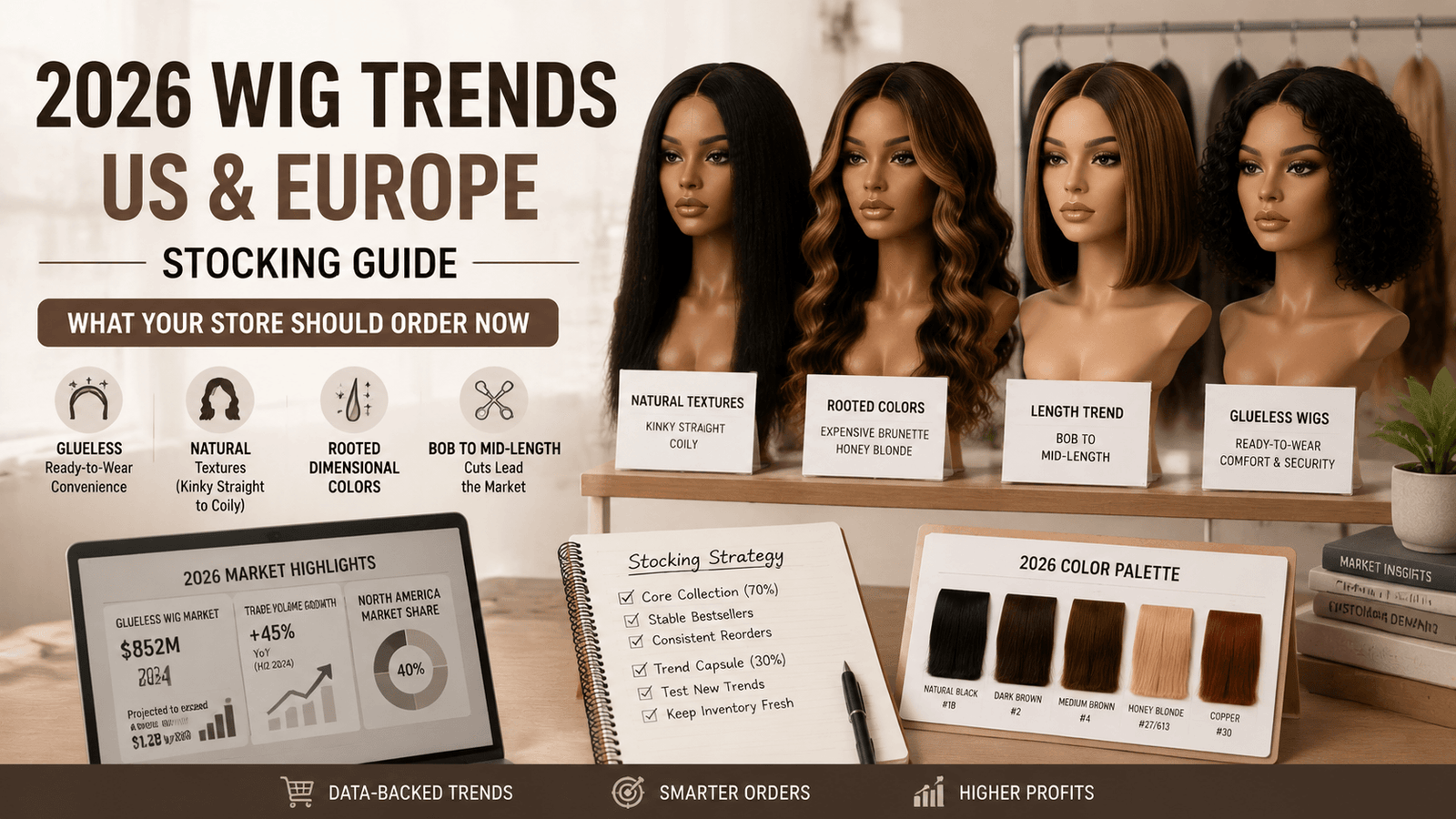
The top wig trends to stock in 2026 are glueless ready-to-wear lace fronts, natural texture families (kinky straight through coily), rooted dimensional colors (especially expensive brunette), and bob-to-mid-length cuts, with HD lace now a baseline expectation, not an upgrade. If you are a store owner placing orders right now, these four categories should dominate your inventory budget.
Last November, a boutique owner in Manchester ordered 200 units based on what was trending on TikTok the month before. By the time her shipment arrived in January, half the styles had already cycled out of relevance. She spent the first quarter marking down inventory instead of marking it up.
The wig market in 2026 moves faster than most store owners realize. The stores that win aren't the ones chasing every viral moment, they're the ones that build a disciplined core inventory, test trends with small bets, and know how to separate a real demand signal from algorithmic noise. This guide breaks down exactly what to order, for which market, in what quantities, and when.
Key Takeaways - Glueless ready-to-wear lace fronts are the single most important inventory category in 2026, $852 million market, +45% YoY trade volume growth - Natural texture families (kinky straight, coily, deep wave, body wave) drive the most consistent reorders, stock them in 3-SKU mini-collections - Rooted dimensional colors (expensive brunette, honey blonde, copper) are replacing flat single-process shades across both US and European markets - US buyers prioritize convenience and viral aesthetics; European buyers prioritize sustainability and "quiet luxury", your inventory ratio should reflect this - The Core + Trend Capsule model (70% stable replenishment, 30% seasonal tests) protects your cash flow while keeping your store relevant
The 2026 Wig Market at a Glance
The global wig and hair extensions market sits between $13 billion and $15 billion in 2026, growing at 6% to 9% annually. North America accounts for roughly 40% of global sales, the single largest regional market. Europe holds 20% to 22%, but the UK (9.7% CAGR) and France (9.3% CAGR) are growing faster than the North American average of 8.8%.
What matters for your ordering decisions isn't just the size of the market, it's the shift in how customers buy. Three things are happening at once:
First, human hair still dominates (roughly 65% of market value), but advanced synthetic fibers are growing at 6% CAGR because they now look convincing enough for fashion-forward buyers who want variety without the price tag.
Second, the glueless segment is exploding. China Customs data shows a 45% year-over-year increase in glueless wig trade volume in the second half of 2024 alone. The global glueless wig market hit $852 million and is on track to pass $1.2 billion by 2030.
Third, customers are buying more wigs per year than ever before. The "one wig, one look" era is over, and it's not coming back. Your average customer now owns 3 to 5 wigs, one for daily wear, one for events, one for content, and one or two for experimenting with colors or textures.
What this means for your store: demand is growing, but so are customer expectations. The wigs you ordered in 2024 will not satisfy buyers in 2026. Here is what will.
The 8 Trends Worth Your Inventory Budget
1. Glueless Ready-to-Wear Wigs (Priority: Critical)
This isn't just a trend, it's a structural shift in how customers expect wigs to work. Glueless wigs come with adjustable straps, silicone grip bands, and pre-attached combs. The customer takes it out of the box, adjusts two straps, and wears it. No adhesive, no salon appointment, no waiting for glue to dry.
The numbers back this up: the global glueless wig market is valued at $852 million and growing at 7% annually. Wholesale trade volume jumped 45% year-over-year in late 2024. Across every demographic and every region, glueless is the fastest-growing construction type.
What to stock:
| Spec | Recommendation |
|---|---|
| Construction | HD lace front, glueless (adjustable straps + silicone grip + combs) |
| Density | 130% to 150% (lightweight, natural movement) |
| Colors | Natural black (#1B), dark brown (#2), medium brown (#4) |
| Textures | Body wave and loose wave (lowest return rates) |
| Length | 18 to 24 inches (broadest market coverage) |
| Hairline | Pre-plucked with pre-bleached knots |
| Wholesale premium | $3 to $8 more per unit vs traditional lace (retail markup: $15 to $30) |
Expect to pay $3 to $8 more per unit at wholesale compared to traditional lace fronts, but the retail markup more than covers the difference — glueless commands a $15 to $30 premium at retail.
A salon owner in Atlanta told us she switched 40% of her inventory to glueless in early 2025. Her return rate dropped from 18% to under 10% within three months. Why? Because the #1 reason customers returned wigs was "I could not get the lace to look right." Glueless removes the installation skill barrier.
Ready to add glueless wigs to your inventory? We can send you samples in 3 different textures so you can test which ones your customers prefer before committing to bulk. WhatsApp us at +86 17347350405 for a sample quote.
2. Natural Texture Families (Priority: Critical)
The biggest texture story of 2026 is the demand for authenticity over uniformity. Customers no longer want wigs that look "done." They want wigs that look like their hair, but better.
The textures driving the most consistent B2B reorders are kinky straight, coily (3C to 4C), deep wave, blown-out yaki, and loose body wave. Each serves a different customer need:
| Texture | Customer Profile | Return Risk |
|---|---|---|
| Kinky straight | Professional, natural look, "pressed hair" aesthetic | Low, matches many customers' natural texture |
| Coily (3C-4C) | Identity-driven purchase, high loyalty | Medium, requires care education to prevent matting |
| Deep wave | Event and glam wear, social media content | Medium, tangling if brushed dry |
| Body wave | Everyday versatile, broadest appeal | Lowest, forgiving texture, easy maintenance |
| Blown-out yaki | Relaxed hair look, natural blending | Low, strong repeat purchase pattern |
The winning stocking strategy for 2026 is not to buy "one curly wig." It is to stock texture families, 3 SKU mini-collections per texture type. For example: body wave in 18 inches, 22 inches, and 24 inches, all in natural black or dark brown, all in 150% density. Customers who like the texture will buy it in multiple lengths for different occasions.
When Marcus, an e-commerce seller based in London, switched from stocking random textures to organized texture families in Q3 2025, his average order value increased by 35%. Customers who bought one body wave wig came back within six weeks to buy the same texture in a different length. The repeat purchase pattern was not random; it was structural.
3. Rooted and Dimensional Colors (Priority: High)
Flat, single-process color is out. The dominant color trend across both the US and Europe in 2026 is dimensional color, darker roots fading into lighter mids and ends, multi-tonal balayage effects, and rich browns with subtle warm undertones..
"Expensive brunette" is the biggest color story. Think deep chocolate bases with chestnut, mahogany, or cinnamon lowlights. It photographs beautifully, reads as natural under both indoor and outdoor lighting, and makes synthetic fibers look significantly less artificial. For synthetic wigs especially, rooted coloring is a game-changer, the darker root hides the unnatural uniformity that gives away a synthetic unit.
Other high-demand shades for 2026 include honey blonde (summer staple, reflects heat for cooler wear), cowboy copper and spiced copper (deeper earthier reds surging in fall/winter), and champagne blonde with rooted shadow roots (the modern alternative to harsh platinum).
Your color strategy should split into two tracks: a core natural palette of 4 to 6 shades (natural black, dark brown, medium brown, honey blonde, and one warm-toned balayage) that replenishes year-round, plus a small fashion-color capsule (deep auburn, muted burgundy, or soft lavender) that rotates seasonally in shallow buys.
4. Bobs, Bixies, and Mid-Length Cuts (Priority: High)
Shoulder-grazing lengths are the workhorses of 2026. They are wearable for office environments, photographable for social content, comfortable for all-day wear, and forgiving for first-time wig buyers.
The power bob, sharp, blunt, hitting right at the jawline, is the defining cut of the year. It projects confidence, requires less maintenance than longer lengths, and costs less to produce (less hair = lower unit cost at the same density). For synthetic wigs, bobs solve a real problem: shorter lengths mean less friction, less tangling, and fewer returns.
The bixie (bob-pixie hybrid) is a fresh silhouette gaining traction especially in European markets and with Gen Z buyers in the US. It is wispy, textured, and featherlight, maximum style with minimal weight.
For your inventory, bobs and mid-length cuts should make up roughly 40% to 50% of your style assortment. They have the broadest demographic appeal and the lowest return rate of any length category. Stock them in body wave and straight textures across 2 to 3 color shades each.
5. HD and Ultra-Thin Swiss Lace (Priority: High, Now a Baseline)
HD lace is no longer a premium upgrade, it is what customers expect. The "invisible hairline" standard set by social media influencers has trained buyers to inspect lace transparency the way they used to inspect hair texture.
The market reflects this: the global lace wigs segment is valued at $3.5 billion, growing at 8.2% CAGR and projected to reach $6.8 billion by 2033. Within that, HD lace captures an increasing share as manufacturing costs come down and quality improves.
What this means for ordering: if you are still stocking standard lace in 2026, you are positioning yourself at the budget end of the market. That is a valid strategy, but be intentional about it. For mid-tier and premium SKUs, HD lace or ultra-thin Swiss lace should be your default specification.
The trade-off worth knowing: HD lace is thinner and more invisible, but it is also more fragile. Swiss lace is slightly more visible but lasts 2 to 3 times longer with daily wear. For first-time buyers entering the premium segment, Swiss lace has lower return rates. For the "Instagram-perfect" customer segment, HD lace is non-negotiable.
A practical stocking split: 60% Swiss lace for your reliable daily-wear SKUs, 40% HD lace for your premium and content-driven SKUs. Track return rates by lace type over two quarters and adjust the ratio based on what your specific customers actually keep.
6. Men's Hair Systems (Priority: Medium, Growing Fast)
The men's segment is one of the most understocked categories in the wig market, and that understocking represents a genuine opportunity for independent retailers.
Grey and silver hair systems for men saw search volume spikes of over 25% during seasonal events in 2025, driven partly by the "Silver Pride" movement and partly by younger men adopting grey as a deliberate fashion statement. This is not just an older demographic, men in their 20s and 30s are buying grey and salt-and-pepper units as style pieces.
The men's hair replacement market more broadly is growing as the stigma around hair systems collapses. Modern units use ultra-thin skin bases or fine lace that is undetectable to touch and sight. Price points at the mid-tier synthetic level (€20 to €30 wholesale, retailing at €60 to €120) make this an accessible add-on category for stores that currently only stock women's wigs.
If you are testing this category, start with 3 SKUs: one everyday natural black skin-base system, one salt-and-pepper lace front, and one active-lifestyle unit with extra-strong adhesion. Track sell-through for two quarters before deepening your assortment.
7. Sustainable and Ethically Sourced Wigs (Priority: Medium, Essential for Europe)
Sustainability is a nice-to-have in the US market in 2026. In Europe, it is rapidly becoming a requirement.
European consumers increasingly demand documentation of ethical sourcing for virgin human hair, traceable donor origins, fair compensation, and chemical-free processing. On the synthetic side, recycled ocean-plastic fibers and bio-based polymers are emerging as differentiators that justify premium pricing.
The UK and French markets are leading this shift. If you sell into Europe, stock at least a portion of your inventory from suppliers who can provide sourcing documentation. For synthetic SKUs, look for manufacturers using bio-based or recycled materials, these products can command a 15% to 25% retail premium over standard synthetics with the right positioning.
For the US market, sustainability is a growing conversation but not yet a purchase driver for most customers. Stock a small pilot assortment (2 to 3 SKUs) with eco-positioning and test whether your specific customer base responds before scaling.
8. Custom and Private-Label Wigs (Priority: Medium, Margin Play)
Private labeling is the strongest defense against price comparison. If a customer can Google your product and find the same unit for $30 less on a marketplace, you do not have a brand; you have inventory.
Custom packaging, branded labels, and exclusive color names make your products un-Googleable, which protects your margins. The upfront investment is higher, most factories require higher MOQs for private label runs, and packaging design adds cost, but the repeat purchase rates and margin protection justify it for stores doing consistent volume.
Start with your 3 to 5 hero SKUs. Private label those first. Leave your trend-test SKUs unbranded until they prove themselves. This keeps your branding investment focused on the products that actually move.
Want to explore private labeling? We handle custom packaging, labeling, and branding for orders starting at flexible MOQs. Tell us your target aesthetic and we will send you packaging samples alongside your wig samples. Email hello@voretrade.com to get started.
US vs Europe, What Sells Where
If you serve both markets or are deciding which to prioritize, the differences in what customers want are significant enough to affect your ordering decisions.
United States: The US market is fashion-driven, influencer-led, and moves on fast trend cycles. TikTok and Instagram drive discovery. Customers want bold colors, extreme lengths, and glueless convenience. The creator economy has normalized wig-wearing among Gen Z as a cosmetic accessory, no different from changing your nail color. US buyers are more likely to impulse-purchase a wig based on a viral video, which means your trend capsule needs to be responsive and your core needs to be deep enough to absorb demand spikes.
United Kingdom: The UK is the fastest-growing European market (9.7% CAGR), driven heavily by celebrity and influencer culture. British buyers want the polish of US trends but with more restrained execution, a bold color is more likely to be a deep auburn than a neon pink. Quality expectations are high and return rates reflect it.
France: French buyers prioritize salon-exclusive positioning, chemical-free processing methods, and brands that communicate craftsmanship. The "quiet luxury" aesthetic dominates, invisible lace, natural movement, colors that look biological rather than dyed.
Germany and Northern Europe: Sustainability documentation matters more here than anywhere else. Traceable sourcing, eco-certified packaging, and transparent supply chains influence purchase decisions. Stock synthetic options made from recycled or bio-based materials if this is your market.
Practical inventory split: If you sell into both the US and Europe, allocate roughly 60% of your buy to US-aligned SKUs (glueless convenience, natural textures, fashion-forward colors) and 40% to Europe-aligned SKUs (sustainability-documented, refined color palettes, premium construction). Adjust based on your actual sales data each quarter.
The Core + Trend Capsule Inventory Model
The store owners who sleep best at night run two inventory systems in parallel.
Core inventory (60% to 70% of your budget): These are your proven sellers, the SKUs that reorder themselves. Body wave and loose wave textures in 18 to 24 inches, natural shades (1B, 2, 4, 6), HD lace front, glueless construction, medium density (130% to 150%). You replenish these quarterly. You never stock out of your heroes. You negotiate volume pricing on these SKUs because you know you will sell through.
Trend capsule (20% to 30% of your budget): Seasonal colors, new textures being tested, bold fashion shades in shorter cuts. Buy shallow, small quantities, 90-day review windows. If a trend SKU sells through twice and return rates stay under 10%, promote it to core. If it sits, mark it down and exit. Do not fall in love with inventory that is not moving.
Niche and private label (5% to 10% of your budget): Custom programs, exclusive accounts, client-driven special orders. These are higher margin but lower volume. They protect your brand from price comparison.
A store owner in Houston we work with adopted this model in early 2025 after a year of buying everything that trended. Her inventory turns improved from 2.8x to 4.2x annually. She told us the difference was not buying better products, it was having a system that forced her to bet small on trends and bet big on what she already knew sold.
What NOT to Over-Order in 2026
Some of the most expensive inventory mistakes in 2026 will come from ordering what was popular in 2024 without checking whether demand has shifted.
| What to Avoid | Why | What to Stock Instead |
|---|---|---|
| Super-heavy density (180%+) | Reads unnatural, declining except in specific cultural markets | 130% to 150% density, lighter, moves like real hair |
| Flat single-process black (#1B) | Looks "wiggy" to customers trained by social media | Rooted looks, subtle multi-tonal shading, dimensional color |
| Full-lace wigs at entry-level prices | Updo versatility is wasted on most customers; higher unit cost | Glueless lace front, covers 90% of wearing scenarios |
| Cheap synthetic (under $25 wholesale) | 25%+ return rates destroy your margin | Mid-tier synthetic ($35 to $50 wholesale) with 5% return rates |
| Ultra-long synthetic (30 inches+) | Friction causes tangling and matting at extreme lengths | Max 26 inches in synthetic; longer lengths in human hair only |
A quick example on the math of cheap synthetic: A $25 wholesale unit with a 25% return rate effectively costs you $33 per unit sold. A $40 synthetic with better fiber quality and a 5% return rate costs you $42. The $9 difference buys you fewer customer service headaches, fewer negative reviews, and higher repeat purchase rates.
Seasonal Ordering Calendar for 2026
The single most common ordering mistake we see isn't buying the wrong product, it's buying the right product too late.
| Quarter | What to Order | When to Place the Order |
|---|---|---|
| Q1 (Jan-Mar) | Restock core after holiday sell-through. Spring pastels and lighter dimensional colors. | Order by mid-November. Cartons should land by January 10. |
| Q2 (Apr-Jun) | Summer textures (water wave, beach wave). Honey and champagne blondes. Breathable cap constructions. | Order by mid-February. Festival and vacation season starts in May. |
| Q3 (Jul-Sep) | Rich autumn tones (copper, auburn, deep brunette). Back-to-school and professional styles. | Order by early June. Fall inventory should arrive by August 1. |
| Q4 (Oct-Dec) | Holiday glam textures (deep wave, loose curl). Gift-ready packaging. Darker, richer colors. | Order by August 15. October through December is peak selling season, if your cartons arrive in November, you missed 30% of the window. |
The rule: cartons should land 4 to 6 weeks before your promotional peaks. Lead time from Chinese manufacturers typically runs 3 to 5 weeks for production plus 2 to 5 weeks for shipping depending on method (air freight: 7 to 15 days; sea freight: 20 to 45 days). Factor in an additional week at your end for QC inspection before products hit your shelves or listings.
How to Source These Trends From China
Knowing what to order is half the equation. Getting consistent quality from your supplier is the other half.
Here is what to look for in a wig supplier for 2026 trends:
First, the supplier should be familiar with the specific constructions you are ordering. Glueless caps, HD lace, pre-plucked hairlines, and pre-bleached knots are all technical specifications, not marketing terms. A supplier who does not understand the difference between HD lace and standard lace at the manufacturing level will ship you standard lace labeled as HD.
Second, always order physical samples before committing to bulk. Request 2 to 3 units from the same production batch that would fill your order. Pay for the samples, free samples are sometimes produced at higher quality than the bulk run you will receive.
Third, run a wash-and-air-dry test on every sample. Wash the wig with mild shampoo, condition it, let it air dry, and detangle it with a wide-tooth comb. If it mats, tangles excessively, or sheds more than 8 to 10 hairs, do not order in bulk. This single test catches more quality problems than any visual inspection.
Fourth, establish a golden sample system. The unit you approve after testing becomes your reference. Every bulk order is measured against that reference. If the bulk units do not match, the supplier fixes the issue or the order does not ship. This removes subjectivity from quality disputes.
At Voretrade, every order goes through a 4-step verification process before it leaves China: factory audit, sample approval, production QC, and pre-shipment inspection. You receive photos and videos of your actual order before you pay the final balance. If something does not match the approved sample, we catch it before it leaves the country, not after it arrives at your store.
Most store owners we work with start with 10 to 20 pieces per style for a first order, test sell-through, then scale the winners. You don't need to overcommit on a first order. You need to verify that the product sells in your specific market with your specific customers. Everything else is data you collect along the way.
Looking for a supplier who understands 2026 wig specifications? We source glueless HD lace fronts, natural texture families, and custom-color wigs from verified factories with documented QC at every stage. WhatsApp us at +86 17347350405 or email hello@voretrade.com, tell us your target market and we will recommend a starter assortment based on what is selling for similar stores.
Frequently Asked Questions
What is the single safest wig style to order for 2026?
A glueless HD lace front body wave wig in 22 inches, 150% density, natural black or dark brown. This single SKU has the broadest demographic appeal, the lowest return rate, and the most consistent year-round demand across both US and European markets.
How many SKUs should a new wig store start with?
Start with 10 to 15 SKUs: 5 hero human hair styles (body wave in 2 lengths, straight in 1, loose curl in 1, bob in 1), 3 synthetic fast-fashion styles, and 2 to 3 color variants within each hero style. This is enough to look like a real store without spreading your budget too thin.
How much should I budget for my first wholesale wig order?
A starter order of 100 to 150 units across 10 to 15 SKUs typically runs $3,500 to $8,000 at wholesale, depending on human hair vs synthetic mix and construction quality. Add 15% to 25% for shipping depending on method. Most first-time buyers spend $5,000 to $12,000 all-in for a full initial assortment.
What is the biggest mistake first-time wig buyers make?
Ordering too many styles with too little depth in each. A store with 50 SKUs and 2 units per SKU looks thin and sells thin. A store with 12 SKUs and 8 to 12 units per SKU looks stocked and credible. Depth outperforms breadth in the first year.
How do I know if a trend is worth stocking or just noise?
Watch for three signals: the trend appears in both consumer-facing fashion media AND wholesale buyer guides (not just one), multiple suppliers are actively producing it (not just one factory pushing it), and you see real customer search volume or inquiries for it in your own channels. One viral TikTok is not a trend. Sustained demand across multiple indicators is.
What to Do Next
The wig market in 2026 rewards preparation, not reaction. The store owners who will have the best year are the ones placing orders now, not the ones waiting to see what goes viral next month.
Start with your core. Lock in 5 to 8 hero SKUs in glueless HD lace, natural textures, and dimensional colors. Order samples. Test them. Then scale.
Layer in your trend capsule once your core is stable. Buy shallow, review every 90 days, and promote what works.
And find a supplier who treats quality verification as a process, not a promise. Whether you work with us or someone else, make sure every order is inspected before it ships, because the cost of catching a quality problem in China is a fraction of the cost of discovering it through customer returns.
- WhatsApp: +86 17347350405 (fastest response, send your requirements and get a quote within 24 hours)
- Email: hello@voretrade.com (for detailed specifications and documentation)
No minimum commitment to start the conversation. Tell us your market, your budget, and the styles you are considering; we will help you build an assortment that makes sense for your specific customers.