Wig Cap Construction Types: What Every Wholesale Buyer Needs to Know
June 6, 2026 · Marcus Vore
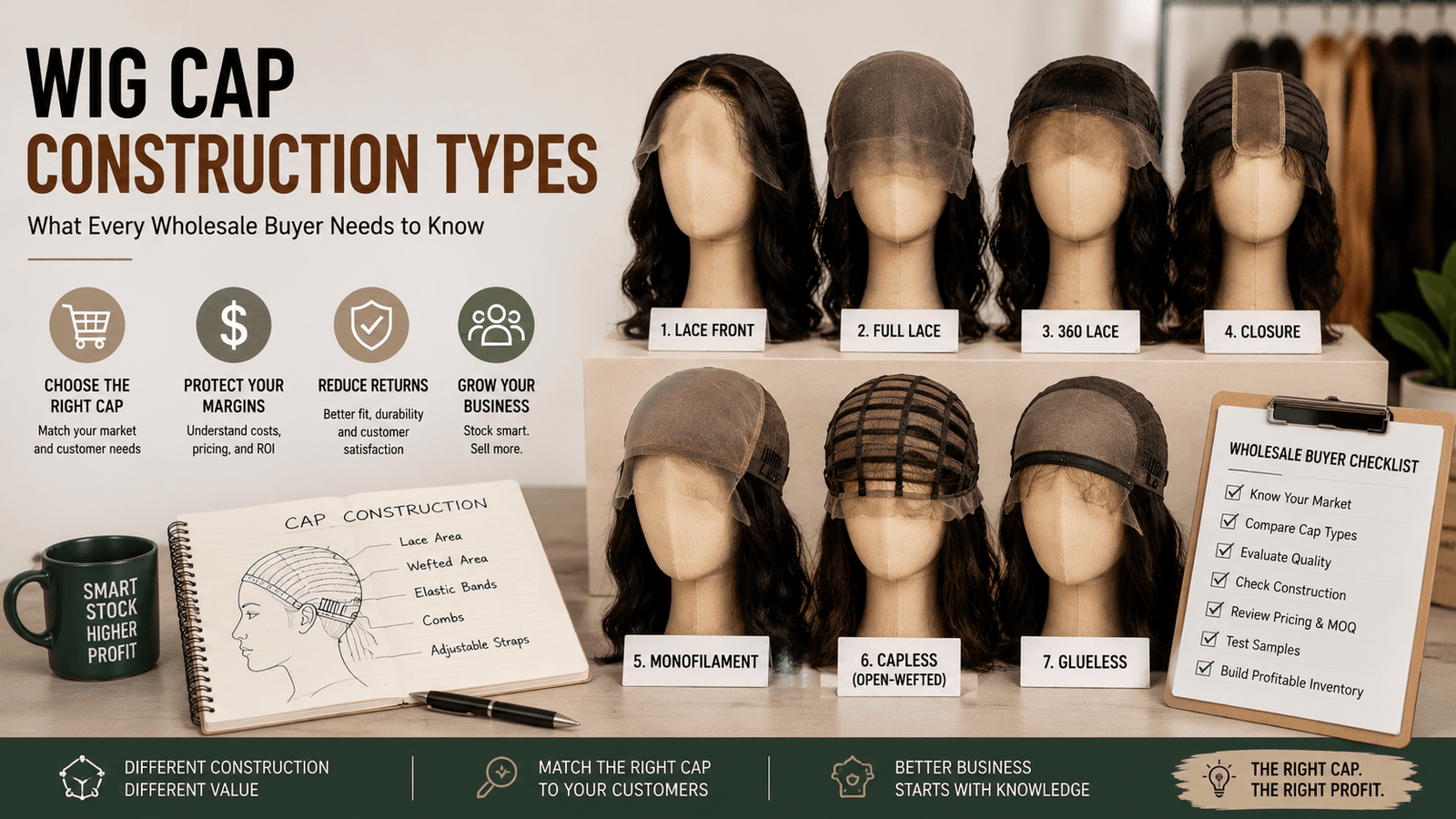
There are seven main wig cap construction types: lace front, full lace, 360 lace, closure, monofilament, capless (open-wefted), and glueless. Each affects a wig's price, durability, styling flexibility, and which customers will buy it. For wholesale buyers, the cap type you stock determines your margin, your return rate, and your brand's reputation in the market.
Last November, Lisa, a salon owner in Atlanta, placed her first wholesale wig order. She stocked 50 units, all full lace, because a supplier told her "full lace is the best." Three months later, she had sold 12 units. Her customers loved the quality, but most walked out when they heard the price: $180 and up. The budget-conscious clients who made up 60% of her foot traffic never even touched the wigs. Lisa learned the hard way that "best" does not mean "best for your market."
By Voretrade Sourcing Team | Last updated: June 2026
Her mistake was not understanding cap construction before buying. Here is what you need to know to avoid the same outcome.
Key Takeaways - Lace front wigs make up 70%+ of volume sales, they are the workhorse of most profitable wig businesses - Full lace wigs command the highest retail markup ($150-$400+) but take 40-100 hours of hand-tying per unit, expect 4-6 week lead times - 360 lace is the fastest-growing middle ground, giving customers ponytail and updo versatility without the full lace price tag - Glueless cap engineering is the defining trend of 2026, demand is surging across the US, European, and Middle Eastern markets - The cap type you stock shapes your customer profile, price ceiling, and return rate, stock based on your market, not supplier recommendations
What is wig cap construction (and why it matters for your inventory)
Wig cap construction refers to how the base of the wig is built, the material used, how hair is attached, and how the cap fits the wearer's head. Think of it as the foundation of a house. The hair is the paint and furniture. If the foundation is wrong, nothing else matters.
For a wholesale buyer, cap construction directly affects six business decisions:
- Your wholesale cost per unit, full lace costs 2-3x more than closure or capless wigs purely because of labor
- Your retail price ceiling, customers will pay more for hand-tied lace than machine-wefted caps, but only in the right market
- Your return rate, fit issues, lace tearing, and "does not look natural" complaints all trace back to cap construction
- Your lead times, full lace wigs take 4-6 weeks to produce; machine-wefted lace fronts ship in 2-3 weeks
- Your customer profile, beginners buy lace fronts and closures; experienced wearers buy full lace and 360
- Your brand positioning, premium brands stock hand-tied and monofilament; value brands stock capless and closure
Marcus, an e-commerce seller based in London, stocked 200 lace front wigs for his Shopify store in March 2025. His return rate hovered around 8%, mostly from customers complaining the wigs "looked fake" at the crown. The issue was not the hair, it was the cap. He was selling lace fronts with a fixed center part to customers who wanted to switch between middle and side parts. When he added 50 monofilament-top lace fronts (free-part crown) to his inventory, his return rate on those units dropped to under 3%. Same supplier, same hair grade, different cap construction, entirely different customer satisfaction.
The 7 wig cap construction types explained
1. Lace front wig caps, the volume leader
A lace front wig has a sheer lace panel across the front hairline, typically 13x4 or 13x6 inches from ear to ear. The rest of the cap is built with machine-sewn wefts on a durable base material.
This is the most popular construction in the world. It gives a natural-looking hairline at a price that works for the broadest range of customers.
Production time: 2-4 hours per unit. The front lace section is hand-tied (1-2 hours); the back is machine-wefted (1-2 hours).
Best for: Beginners, everyday wear, budget-conscious customers, volume-focused wholesale buyers.
Pros for your business: - Lowest wholesale cost of the lace wig category ($30-60 FOB for human hair, depending on length and density) - Fastest production turnaround (2-3 weeks standard) - Most durable construction, the wefted back withstands daily handling - Widest customer base, suitable for first-time wig buyers and daily wearers
Cons to consider: - Cannot wear high ponytails or updos (machine wefts at the back will be exposed when hair is lifted) - Limited parting space, typically a fixed or narrow part in the front lace area - Less breathable at the crown compared to full lace
Stocking recommendation: If you can only stock one cap type, make it lace front. It satisfies the broadest market and carries the lowest inventory risk.
2. Full lace wig caps, the premium standard
A full lace wig has the entire cap made of lace. Every single hair strand is hand-tied individually into the lace base. There are no machine wefts anywhere on the cap.
Production time: 40-100+ hours per unit. A skilled technician hand-knots each strand. One worker can produce roughly 2-3 full lace caps per week.
Best for: Premium markets, experienced wig wearers, special occasions, customers who demand maximum styling flexibility.
Pros for your business: - Highest retail markup, wholesale at $80-150 FOB, retail at $200-500+ - Maximum styling versatility, customers can part anywhere, wear high ponytails, braids, and updos - Most breathable construction, ideal for hot climates and all-day wear - Most natural appearance from every angle, fewer "looks fake" complaints
Cons to consider: - Highest wholesale cost (2-3x more than lace front equivalents) - Longest lead times (4-6 weeks minimum, longer during peak seasons) - Most fragile, lace is delicate and tears if handled roughly by customers - Higher return rate from handling damage (customers tear the lace during installation, then claim defect)
Stocking recommendation: Stock full lace as 15-25% of your inventory unless your entire brand is built on the premium segment. It commands the highest margins but also carries the highest per-unit risk.
3. 360 lace wig caps, the best of both worlds
A 360 lace wig has a band of lace running around the entire perimeter of the head, front, sides, and back. The center crown area is a machine-wefted cap with a stretch panel.
This construction gives you a natural hairline all around, which means ponytails and updos are possible, but at a lower cost than full lace.
Production time: 6-12 hours per unit. The perimeter lace sections are hand-tied; the crown is machine-wefted.
Best for: Customers who want ponytail/updo options without paying full lace prices, active lifestyles, the growing "middle premium" segment.
Pros for your business: - Natural hairline from all angles, front, sides, and nape - High ponytails and updos are fully supported (the lace edge conceals wefts when hair is up) - More affordable wholesale than full lace ($50-90 FOB for human hair) - More durable than full lace, the wefted crown adds structural stability
Cons to consider: - Cannot part hair freely in the crown, only along the perimeter lace - Slightly less breathable at the top than full lace - One-size-fits-most cap with limited adjustability (check with your supplier about size options)
Stocking recommendation: 360 lace is the fastest-growing segment for a reason. Stock it as 25-35% of your inventory if your customers are under 40 and active on social media. This is the construction TikTok and Instagram are driving demand for.
4. Closure wig caps (4x4, 5x5, 6x6), the budget-friendly entry point
A closure wig has a small lace or silk piece at the crown area only, 4x4, 5x5, or 6x6 inches. The rest of the cap is machine-wefted.
Production time: 1-2 hours per unit. The small closure piece is hand-tied; everything else is machine work.
Best for: Budget-conscious buyers, first-time wig wearers, high-volume/low-margin wholesale models, markets where price is the primary purchase driver.
Pros for your business: - Lowest wholesale cost in the lace category ($20-40 FOB) - Quickest production (1-2 weeks) - Very durable, minimal lace means fewer handling issues and returns - Beginner-friendly, customers need minimal skill to install
Cons to consider: - Very limited styling, essentially a fixed part with a natural-looking crown - No ponytail or updo capability - Lower perceived value, harder to command premium retail pricing
Stocking recommendation: Stock closures if you are selling into price-sensitive markets or building a budget-friendly product line. They serve the entry-level customer who will upgrade to lace front or 360 lace on their second or third purchase.
5. Monofilament (mono top) caps, the medical-grade option
A monofilament cap uses a sheer polyurethane or nylon mesh panel at the top, with each hair individually hand-tied to create the appearance of natural hair growth from the scalp.
This construction is common in medical wigs (for alopecia and chemotherapy patients) because the soft mesh is gentle on sensitive scalps.
Production time: 8-20 hours for the mono top section. Often combined with lace front for a hybrid construction (mono top + lace front).
Best for: Medical and hair-loss markets, premium salons, customers with sensitive scalps, buyers who prioritize realism at the part above all else.
Pros for your business: - Most realistic scalp appearance at the part, hair appears to grow directly from the mesh - Multi-directional parting, customer can change part position freely within the mono area - Soft and non-irritating for sensitive or bare scalps - Premium positioning with a medical-market angle
Cons to consider: - Higher wholesale cost than standard lace fronts (20-30% premium) - Heavier than full lace (the mono mesh adds weight) - Less breathable than lace constructions - Smaller customer base, primarily medical and premium segments
Stocking recommendation: If you sell to salons that serve hair-loss clients, stock at least one mono-top option. This customer segment is loyal and less price-sensitive, they value comfort and realism above cost.
6. Capless / open-wefted caps, maximum breathability
Capless wigs use machine-sewn hair wefts attached to vertical strips of material with open spaces between each row. There is no closed cap layer.
Production time: Under 1 hour per unit. Fully machine-made.
Best for: Hot climates, budget fashion wigs, synthetic hair lines, customers who prioritize comfort and lightness over realism.
Pros for your business: - Cheapest wholesale cost ($5-15 FOB for synthetic; $15-30 for human hair blends) - Lightest weight and most breathable, ideal for summer and warm-climate markets - Fastest production, fully machine-made with minimal labor - Very low MOQs available (some Yiwu factories will do 100-200 units)
Cons to consider: - Least natural-looking, visible wefts at the crown and part - No realistic hairline or parting - Lower retail price ceiling - Higher return rate from "does not look real" complaints
Stocking recommendation: Best suited for fashion customers who change styles frequently or synthetic hair lines targeting the under-$50 retail segment. Not recommended as a primary offering if your brand positions on quality or realism.
7. Glueless caps, the 2026 trend reshaping the market
Glueless wigs use integrated elastic bands, adjustable straps, and sewn-in combs (sometimes with silicone grip strips at the nape and ear tabs) to secure the wig without adhesive. The cap design itself provides the hold.
This is not a standalone cap type, glueless engineering is applied to lace front, 360 lace, and full lace wigs. But it has become such a dominant demand driver that it deserves its own category in any buyer's inventory plan.
Production time: Adds roughly 30-60 minutes to standard production for band and comb installation.
Best for: The broadest possible market, beginners, daily wearers, sensitive-skin customers, and anyone who does not want to deal with glue.
Why glueless is dominating 2026: - Removes the #1 barrier for first-time wig buyers (fear of adhesive) - Protects natural edges from glue-related damage - Cuts installation time from 30-60 minutes (glued) to under 5 minutes - Growing social media content around "throw on and go" wigs
What to check when sourcing glueless caps: - Elastic band type: silicone-lined bands grip better but cost more - Comb placement: minimum 3 combs (one at crown, two at sides); 5 combs (adding nape) for larger cap sizes - Strap adjustability: velcro straps should have at least 1 inch of adjustment range - Silicone grip: premium glueless caps include a silicone strip at the nape for slip-free wear
Sarah, a first-time importer in Toronto, placed a 100-unit order of lace front wigs in January. She chose standard caps (no glueless features) because they saved her $3 per unit. Her customers, mostly young professionals buying wigs for the first time, did not know how to use adhesive. Her return rate hit 22% in the first two months, driven almost entirely by "won't stay on" complaints. She restocked with glueless versions of the same wigs. The return rate on the second batch: 6%. The $3 she saved on the first order cost her roughly $1,800 in returns and lost repeat customers.
Lace front vs full lace vs 360 lace: the detailed comparison
When buyers ask us "which one should I stock?", the answer is rarely one type. It is a ratio based on your market. Here is the side-by-side comparison that makes the trade-offs clear.
| Factor | Lace front | 360 lace | Full lace |
|---|---|---|---|
| Lace coverage | Front hairline only (ear to ear) | Full perimeter (front, sides, back) | Entire cap |
| Parting freedom | Limited to front lace area | Unlimited around perimeter | Unlimited everywhere |
| Ponytails and updos | No (tracks exposed at back) | Yes | Yes |
| Wholesale cost (human hair) | $30-60 FOB | $50-90 FOB | $80-150 FOB |
| Retail price range | $80-180 | $130-280 | $200-500+ |
| Production lead time | 2-3 weeks | 3-4 weeks | 4-6 weeks |
| Breathability | Moderate (front only) | Good | Excellent |
| Beginner-friendly | Yes, easiest install | Moderate | Requires experience |
| Return rate (typical) | 6-10% | 8-12% | 10-18% |
| Best-selling market | US general, Europe, budget-conscious | Social-media-driven buyers, under-40 | Premium, luxury, special occasion |
What drives the cost difference
The cost gap is almost entirely labor, not materials. Lace material costs are similar across all three types, roughly $3-7 per cap depending on lace quality (HD vs Swiss vs transparent).
What changes is the hand-tying hours: - Lace front: 1-2 hours of hand-tying (front lace section only) - 360 lace: 4-8 hours of hand-tying (full perimeter lace band) - Full lace: 40-100+ hours of hand-tying (entire cap, every strand)
A factory worker in Xuchang hand-tying a full lace cap spends roughly two to three full workdays on a single unit. That labor cost is the real reason full lace retails for $200+ while lace front retails for under $100. Browse our product catalog to see how different cap constructions translate to finished wigs.
How wig caps are made: inside a Chinese factory
Understanding how each cap type is produced helps you ask better questions of suppliers and catch quality issues before they reach your customers.
Machine-wefted production (lace front, closure, capless)
Machine-wefted sections are produced on industrial sewing machines. Hair is fed into the machine in bundles, which stitches the hair onto a base material in rows. A skilled machine operator can weft enough hair for 20-30 caps per day.
The production steps: 1. Hair is sorted by length and bundled into weft-ready groups 2. The base cap material is cut to pattern (S, M, L sizes) 3. Wefts are machine-sewn onto the cap in horizontal rows, starting from the nape and working up 4. For lace fronts and closures, the lace piece is hand-attached at the designated section 5. Elastic bands, combs, and adjustment straps are sewn in
The key quality checkpoint for machine-wefted caps: check weft row spacing. Rows should be 0.5-0.8 cm apart. Closer rows mean more hair and a fuller look, but also more weight and less breathability.
Hand-tied production (full lace, mono top, 360 perimeter)
Hand-tied sections involve a technician using a ventilating needle to knot individual strands of hair into the lace or mono mesh. Each knot is tied by hand.
The production steps: 1. The lace or mono cap is stretched onto a block (a wooden head form) 2. A technician works section by section, ventilating 1-3 hairs per knot 3. Knot density varies by specification: 150% density requires more knots per square inch than 130% 4. After ventilating, knots are bleached (for transparent/HD lace) to reduce visibility 5. The completed cap is washed, conditioned, and styled
The key quality checkpoint for hand-tied caps: check knot consistency. Knots should be uniform in size and spacing. Loose or oversized knots indicate rushed production. Run your finger across the inside of the lace, knots should feel smooth, not bumpy or raised.
Regional specialization
| Region | Specialty | Best for |
|---|---|---|
| Xuchang, Henan | Full lace, HD lace, premium human hair | High-end, labor-intensive constructions |
| Qingdao, Shandong | Machine-wefted, synthetic, mid-range | Cost-competitive lace fronts and closures |
| Yiwu, Zhejiang | Agile small-batch, rapid prototyping | Low-MOQ orders, headband wigs, testing new styles |
| Guangzhou, Guangdong | Medical-grade monofilament, custom orders | Premium customization, fast air freight access |
Most of our wig production partners are based in Xuchang. The city produces roughly 70-80% of the world's human hair wigs. The specialization there, particularly in full lace and HD lace, means higher consistency on complex hand-tied constructions. Learn more about how we verify quality at every production stage.
Which cap construction should you stock for your market
The right answer depends on who you sell to and at what price point. Here is what we see working across our buyer base.
For salon owners and beauty supply retailers
Your walk-in customers want to see and touch the product before buying. They also range from first-timers to experienced wearers.
Recommended mix: 50% lace front, 25% 360 lace, 15% closure, 10% full lace.
Start with lace fronts as your core inventory. Add 360 lace for the customers who ask "can I wear this in a ponytail?" Add a few full lace units as your premium showcase pieces, they may not move as fast, but they establish your salon as a quality destination.
For e-commerce and DTC brands
Online buyers cannot touch the product. They rely on photos, videos, and reviews. This means glueless and HD lace, the constructions that photograph best, should be your priority.
Recommended mix: 40% glueless lace front (HD lace), 30% glueless 360 lace, 20% standard lace front, 10% full lace.
Invest in product photography that shows the cap construction clearly. A 30-second video of someone putting on a glueless wig and adjusting the straps converts better than 10 product photos.
For first-time importers and budget-conscious startups
Keep it simple. Do not spread your first order across five cap types. Stock two, learn what sells, and adjust.
Recommended mix: 70% lace front (standard or HD lace), 30% 360 lace (glueless if budget allows).
Order samples in both constructions before committing. Wear them, wash them, brush them. If the quality holds up after two weeks of handling, you have a viable product. If it starts shedding or the lace frays, find a different supplier. Factor in shipping costs and transit times when calculating your landed cost per unit, air freight runs 7-15 days, sea freight 20-45 days depending on destination.
For premium and luxury wig brands
If your brand competes on quality and realism rather than price, your inventory should reflect that.
Recommended mix: 40% full lace (HD or Swiss lace), 30% 360 lace (HD perimeter), 20% mono-top hybrid (mono crown + lace front), 10% lace front (HD, pre-cut, pre-plucked).
At this price point, every detail matters. Your customers will inspect the knots, the lace transparency, and the hairline under bright light. Quality issues that are acceptable at the $80 price point will generate returns at $250+.
Cap construction quality control: what to inspect before approving a bulk order
When samples arrive, cap construction is one of the first things to check. Here is what to look for by cap type.
Lace transparency and knot quality
- Hold the lace against your skin under natural light. It should blend, if the lace looks like a visible mesh patch, the color or material is wrong for your market.
- Flip the wig inside out and inspect the knots. They should be uniform in size, tight, and evenly spaced. Bleached knots should be a consistent light color, patchy bleaching means inconsistent production.
- On HD lace specifically: hold it up to a window. Real HD lace (0.03-0.05mm thickness) should be nearly transparent. If it looks similar to regular lace when backlit, the supplier may be using standard lace labeled as HD.
Cap fit and measurement tolerances
Fit is the #1 driver of returns across all cap types. When customers say a wig "feels wrong," they usually mean the cap does not fit.
Check these three measurements on every sample: - Circumference: Measure around the hairline (front to nape, ear to ear). Standard medium is 21.5-22.5 inches. +-0.5 inch is acceptable. - Front to nape: Measure from the center of the front hairline to the bottom of the cap at the nape. Standard is 14-15 inches. - Ear to ear across forehead: Measure from the top of one ear, across the forehead, to the top of the other ear. Standard is 11-12 inches.
If three samples from the same batch vary by more than 0.5 inches on any measurement, the factory's cap-cutting consistency is a problem. That variation will translate to customer returns. These cap construction checks are part of a larger verification process, see our complete guide to choosing a reliable wig supplier from China for the full sourcing checklist.
Density consistency across the cap
Part the hair at the crown, the sides, and the nape. The density should look consistent. If the crown is noticeably thinner than the perimeter, the supplier is concentrating hair at the visible edges and skimping where it matters.
Glueless feature testing
For glueless caps, test every securing mechanism: - Elastic band: stretch it 10 times. It should snap back fully, no permanent stretch. - Combs: tug each comb gently. They should be firmly sewn in, with at least 3-4 stitches per comb. - Straps: adjust the velcro straps through their full range. They should hold position without slipping. - Fit test: wear the wig for 2-3 hours with normal movement. It should stay in place without adhesive.
Frequently asked questions
What is the best wig cap construction for beginners?
Lace front and closure wigs are the most beginner-friendly. They offer a natural hairline with simple installation, no adhesive required for glueless versions. Start your customers here, and they will come back to you when they are ready to upgrade to 360 lace or full lace.
Which wig cap looks most natural?
Full lace looks most natural from every angle because the entire cap is hand-tied lace with no visible wefts. However, a well-made lace front with HD lace and a pre-plucked hairline can look nearly as natural from the front, and most people only see the front of a wig in daily life.
Can you wear a high ponytail with a lace front wig?
No. Lace front wigs have machine wefts at the back that will be exposed if the hair is lifted. For high ponytails and updos, choose a 360 lace or full lace wig.
What is the difference between 13x4 and 13x6 lace?
These numbers describe the lace panel dimensions in inches on a lace front wig. 13x4 means 13 inches ear-to-ear and 4 inches front-to-back. 13x6 means 13 inches ear-to-ear and 6 inches front-to-back. The extra 2 inches of depth on a 13x6 gives more parting space and a more natural-looking scalp when the hair is pulled back. Wholesale cost difference is typically $5-10 per unit.
How long does a hand-tied wig cap last?
With proper care, a full lace or hand-tied mono cap lasts 6-12 months of regular wear. Swiss lace tends to last longer (closer to 12 months) while HD lace is more delicate (closer to 6 months). Educate your customers on proper handling, most cap damage comes from aggressive brushing and pulling, not from material failure.
Is HD lace worth the extra cost?
For your retail customers, yes, HD lace commands a $15-30 retail premium and drives purchase decisions among social-media-influenced buyers. For your wholesale budget, the math is tighter. HD lace adds $3-8 per unit at wholesale. If you can pass that cost through to retail with margin intact, stock it. If your market is price-sensitive, transparent or Swiss lace performs nearly as well at a lower cost.
What is a glueless wig cap and how does it stay on?
A glueless wig uses elastic bands, adjustable velcro straps, and sewn-in combs (sometimes with silicone grip strips) to secure the wig without adhesive. It stays on through tension and friction, the elastic band hugs the head, the combs anchor into natural hair, and the straps create a custom fit. No glue, no tape, no install time.
Stock the right cap construction for your market
The wig cap is not the most exciting part of sourcing, until it goes wrong. Returns, complaints, and dead inventory almost always trace back to a mismatch between what your customers expected and what the cap construction delivered.
Start with your market. Who is your customer? What are they willing to pay? How much styling versatility do they expect? Answer those three questions, and the right cap mix follows.
If you are unsure, start narrow: one or two cap types, tested with real customers, then expand based on what sells. Lisa, the Atlanta salon owner from the beginning, restocked with 70% lace front, 20% 360 lace, and 10% full lace. Six months later, she has sold through three reorders and doubled her wig revenue. Not because she bought "better" wigs, but because she bought the right cap constructions for the customers actually walking through her door.
Need help figuring out the right cap construction mix for your market? Tell us your target customer and budget, we will help you build a stocking plan that matches your market, not someone else's.
- WhatsApp: +86 17347350405
- Email: hello@voretrade.com